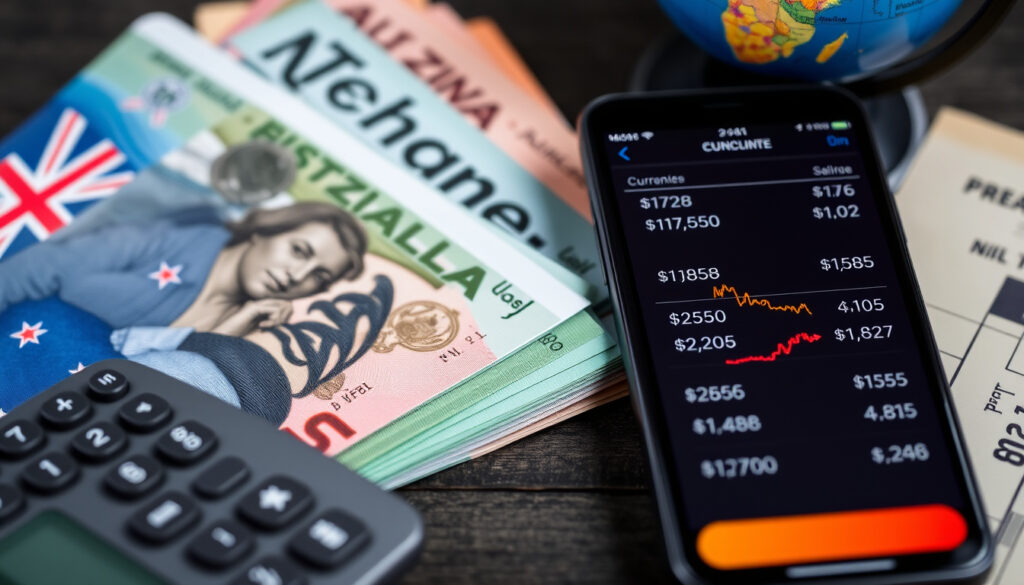
350 AUD to NZD: Exchange Rate, Fees & Travel Tips
Figuring out how much your Australian dollars will get you in New Zealand isn’t as simple as checking the latest exchange rate. Hidden fees, dynamic currency conversion, and ATM surcharges can quietly eat into your travel budget before you even buy your first flat white in Wellington.
Current 1 AUD to NZD mid-market rate: 1.208 NZD ·
350 AUD to NZD at mid-market rate: 422.1 NZD ·
Typical bank transfer fee: 1-3% above mid-market ·
Cost of living index: Australia vs New Zealand: Australia ~15% higher ·
Average 7-day trip to New Zealand cost (per person): NZD 1,500-2,500 ·
Wise AUD to NZD exchange rate margin: 0.5-1.0%
Quick snapshot
- Mid-market rate is publicly available from multiple sources (Wise (money transfer service))
- Cost of living differences are documented by Numbeo (Numbeo (cost-of-living database))
- Whether AUD/NZD rates will stay above 1.20 in the next quarter (MoneyHub NZ (consumer finance guide))
- Exact future travel costs due to inflation (Allianz Travel Insurance (travel insurer))
- 2023 Q4: AUD to NZD reached 1.10 low (XE (currency data provider))
- 2024 Q1: Rate recovered to 1.08-1.12 (XE (currency data provider))
- 2024 Q3: Current rate ~1.208 (peaked in August) (MoneyHub NZ (consumer finance guide))
- Watch RBNZ rate decisions for NZD support (Reserve Bank of New Zealand)
- Compare provider rates before your transfer (Travelex Australia (travel money provider))
The numbers below give a quick factual reference before we dive into the hidden costs.
| Snapshot fact | Value |
|---|---|
| Current AUD to NZD (mid-market) | 1.208 |
| 350 AUD at mid-market | NZD 422.1 |
| 350 AUD with 2% bank fee | NZD 413.7 |
| Australia cost-of-living index | 73.5 |
| New Zealand cost-of-living index | 65.2 |
| 7-day trip budget (low) | NZD 1,500 |
How much is $1 AUD in NZ?
Live mid-market rate today
As of September 2024, the mid-market exchange rate is approximately 1.208 NZD per 1 AUD, according to Wise (money transfer service). This is the rate you see on Google and currency converters — but you’ll rarely get it from a bank or airport kiosk.
Why the rate fluctuates daily
- Interest rate decisions by the Reserve Bank of Australia and the Reserve Bank of New Zealand shift the spread (Reserve Bank of Australia)
- Commodity prices (Australia exports iron ore, NZ exports dairy) affect demand for each currency (ABC News (Australian public broadcaster))
- Market sentiment and economic data releases cause daily swings of 0.5-1% (XE (currency data provider))
A 2% spread on a 350 AUD conversion costs you about NZD 8.40 — enough for a coffee and a slice of cake in Queenstown.
What is $300 AUD to NZD?
300 AUD converted at mid-market
At the current mid-market rate of 1.208, 300 AUD equals 362.4 NZD (Wise converter (money transfer service)). That’s the ideal benchmark.
300 AUD converted with typical bank fees
Most Australian banks add a foreign transaction fee of 2.5–3% and may also charge a flat ATM fee. For example, Travelex Australia (travel money provider) reports CommBank debit cards have a spend rate of about 3.50%, while ANZ, NAB, and Westpac charge around 3%. On 300 AUD, a 3% fee shaves off NZD 10.87, leaving you with only 351.5 NZD.
Three key hidden costs, one clear pattern: spreads, flat fees, and dynamic currency conversion can cost you 5–8% of your transfer amount.
If you use a credit card abroad, you may be hit with both a foreign transaction fee (often 3%) and a cash advance fee (another 2–3%) — that’s up to 6% in charges before you even see the exchange rate (Travelex Australia (travel money provider)).
What is a good AUD to NZD exchange rate?
Comparing mid-market vs retail rates
A “good” rate is one that minimises the gap to the mid-market. Wise (money transfer service) offers rates within 0.5% of mid-market, while banks typically operate at a 2–3% margin. Airport exchange booths can be 5–8% off.
Factors that make a rate ‘good’
- Low or zero commission
- Spread close to 0.5% or less
- No dynamic currency conversion markup
- Transparent fees disclosed upfront (Allianz Travel Insurance (travel insurer))
The trade-off: convenience vs cost. Using a local ATM with a low-fee card gives competitive rates but requires planning. Airport kiosks offer instant cash at a premium.
Is it cheaper to live in NZ or Australia?
Cost of living comparison
The Numbeo (cost-of-living database) cost-of-living index (excluding rent) rates Australia at 73.5 and New Zealand at 65.2 — meaning Australia is about 12.7% more expensive overall. Housing is the biggest driver: Sydney and Melbourne are significantly pricier than Auckland or Wellington.
Housing, food, and transport differences
- Rent in Sydney is roughly 30-40% higher than in Auckland (Numbeo (cost-of-living database))
- Groceries in Australia are about 10% more expensive
- Public transport is comparable in both countries
The implication: if you’re moving from Australia to NZ, your AUD will stretch further — but only if you convert smartly. A 350 AUD monthly rent budget at mid-market becomes NZD 422, which goes further in Auckland than in Melbourne.
How much does it cost for a 7 day trip to New Zealand?
Budget breakdown per person
BNZ (New Zealand bank) warns that hidden costs can break a holiday budget. For a 7-day trip, expect:
- Budget accommodation (hostels/motels): NZD 700-1,000
- Food: NZD 350-500
- Transport (car rental + fuel): NZD 300-600
- Activities: NZD 150-400
Total range: NZD 1,500 to 2,500 per person. Converting 350 AUD at a bad rate could cost you NZD 10-20 extra — small in isolation, but it adds up across a week.
Sample itinerary costs
Five nights in a mid-range motel in Queenstown (NZD 200/night), plus meals and a Milford Sound cruise, easily reaches NZD 2,000 per person.
Why this matters: a 3% fee on every AUD transaction during your trip reduces your spending power by roughly NZD 60 over the week — that’s one dinner out.
How do I convert AUD to NZD without losing money?
Using a mid-market service
- Open an account with a specialist money transfer service — Wise and Revolut offer near mid-market rates with transparent fees (Wise (money transfer service)).
- Check the live rate on their app or website — compare with the mid-market rate on XE (currency data provider).
- Choose the local currency option when paying abroad — always select NZD at the point of sale to avoid dynamic currency conversion (Allianz Travel Insurance (travel insurer)).
- Withdraw larger amounts less often — flat fees per withdrawal make one big ATM trip cheaper than several small ones (Wise (money transfer service)).
Avoiding hidden fees
- Skip airport currency exchange — rates are marked up and often include hidden commission (MoneyHub NZ (consumer finance guide))
- Use a debit card that refunds ATM fees or has no foreign transaction fee
- Never accept to be charged in Australian dollars abroad (Allianz Travel Insurance (travel insurer))
The pattern: the best rate is the one you get by controlling the fees, not by timing the market.
What does ‘yeah nah’ mean in New Zealand?
New Zealand slang explained
“Yeah nah” is a classic Kiwi filler that generally means “no” or “maybe not.” For example: “Do you want another beer?” — “Yeah nah, I’m driving.” It can also soften a rejection. Travelers who understand this phrase will find daily interactions smoother.
Cultural context for travelers
New Zealanders (or Kiwis) use “yeah nah” as a polite way to decline. It’s part of a broader casual communication style. Picking up a few local expressions — “sweet as” (no problem), “chur” (thanks) — can help you connect with locals during your trip.
Provider comparison: Where should you convert your AUD to NZD?
Six common options, one clear pattern: specialist services cost 0.5-1% of your amount, while banks and kiosks run 3-8%.
| Provider | Exchange rate margin vs mid-market | ATM / withdrawal fees | Additional fees |
|---|---|---|---|
| Wise (money transfer service) | ~0.47% (MoneyHub NZ (consumer finance guide)) | $0 ATM fee with card | None |
| ANZ Visa Debit (Australia) | ~1.30% (MoneyHub NZ (consumer finance guide)) | $5.00 per withdrawal (Travelex Australia (travel money provider)) | 3% foreign transaction fee? |
| CommBank debit | ~3.50% (Travelex Australia (travel money provider)) | $5.00 per withdrawal | No separate foreign fee (embedded) |
| NAB/Westpac debit | ~3.00% (Travelex Australia (travel money provider)) | $5.00 per withdrawal | No separate foreign fee |
| Travelex Money Card | 2.95% (Travelex Australia (travel money provider)) | $0 ATM fee | Loading fee |
| Airport kiosk | 5-8% | N/A | Hidden commission (MoneyHub NZ (consumer finance guide)) |
Upsides and downsides of specialist money services vs banks
Upsides
- Near mid-market rates with transparent fees (Wise (money transfer service))
- No hidden commissions or dynamic currency conversion traps
- Can pre-lock rate for large transfers
- Some cards offer fee-free ATM withdrawals (e.g., Wise debit card)
Downsides
- Need to open an account before travel
- Cannot withdraw cash at all ATMs (some only support Visa/Mastercard)
- May not be accepted at small rural businesses
- Transfer limits on new accounts
AUD to NZD rate timeline (2023-2024)
- 2023 Q4: AUD to NZD reached a low of 1.10 — one Australian dollar bought just 1.10 NZD (XE (currency data provider))
- 2024 Q1: Rate recovered to the 1.08-1.12 range (XE (currency data provider))
- 2024 Q3 (current): Rate sits around 1.208, the highest level in over a year (MoneyHub NZ (consumer finance guide))
What we know and what remains uncertain
Confirmed facts
- Mid-market rate for AUD/NZD is publicly available from multiple sources (Wise (money transfer service))
- Cost of living in Australia is roughly 12-15% higher than in NZ (Numbeo (cost-of-living database))
- Australian bank debit cards charge 3-3.5% margin on overseas transactions (Travelex Australia (travel money provider))
- Wise offers AUD to NZD conversion at ~0.47% margin (MoneyHub NZ (consumer finance guide))
What’s unclear
- Whether AUD/NZD will stay above 1.20 through the end of 2024 (Reserve Bank of New Zealand)
- How inflation in New Zealand will affect travel prices in 2025 (Stats NZ (government statistics))
- Which banks will change their foreign transaction fee structures
- Whether the spread on bank cards will narrow in the near future
Perspectives from the experts
Paying in the local currency is generally the better choice because dynamic currency conversion often involves hidden costs and marked-up rates.
Wise (money transfer service)
New Zealand’s cost of living index is 65.2, while Australia’s is 73.5 — that’s roughly 12.7% lower, making NZ more affordable for everyday expenses.
Numbeo (cost-of-living database)
Airport cash exchange can be costly because rates are often marked up and may include hidden commission fees.
MoneyHub NZ (consumer finance guide)
Don’t let hidden costs break your holiday budget while overseas.
BNZ (New Zealand bank)
For the Australian traveler heading to New Zealand, the choice is straightforward: use a specialist transfer service like Wise or Revolut for the best AUD to NZD rate, or accept losing 3-8% of your money to bank fees and airport markups. On a 350 AUD budget, that’s the difference between NZD 422 in your pocket and NZD 388 — about one dinner for two in Auckland. Plan ahead, pay in NZD, and keep your trip budget intact.
For a more comprehensive look at larger transfers, the 1500 AUD to NZD travel budget guide offers additional insights on cross-Tasman spending.
Frequently asked questions
What is the current AUD to NZD exchange rate?
As of September 2024, the mid-market rate is approximately 1.208 NZD per 1 AUD (Wise (money transfer service)). This rate updates continuously.
Why does the AUD to NZD rate change?
It fluctuates due to central bank interest rate decisions, commodity export prices, and market sentiment (Reserve Bank of Australia).
How do I find the best AUD to NZD rate?
Compare rates on a comparison website or use a service like Wise that shows the mid-market rate transparently. Avoid airport kiosks (MoneyHub NZ (consumer finance guide)).
What is the difference between mid-market and retail rate?
Mid-market is the wholesale rate used between banks; retail is what consumers get, which includes a markup of 0.5-3% or more (Allianz Travel Insurance (travel insurer)).
Can I get charged fees on AUD to NZD conversion?
Yes. Banks charge foreign transaction fees (1.3-3.5%), ATM operator fees, and dynamic currency conversion markups (Travelex Australia (travel money provider)).
Is it better to exchange money in Australia or New Zealand?
Online specialist services before you travel usually give the best rate. If you need cash, use an ATM in NZ with a low-fee card (Wise (money transfer service)).
Related reading
More related posts
 The Sands Hotel Hokianga: Beachfront, Prices, Menu & Contact
 Blues vs Crusaders 2025: Results, How to Watch & Rivals
 Justice of the Peace: Role, Salary, and Differences
 House Movers North Shore: Costs, Red Flags & Moving Day Guide
 Stuff New Near New Zealand: Late t Breaking New & Update
 Best Electric Lawn Mower 2026: Top 5 UK Picks Compared
 Tolaga Bay Area School: Profile, Principal, Reviews & ERO Report
 What Is a Resume – Definition, Examples and Guide