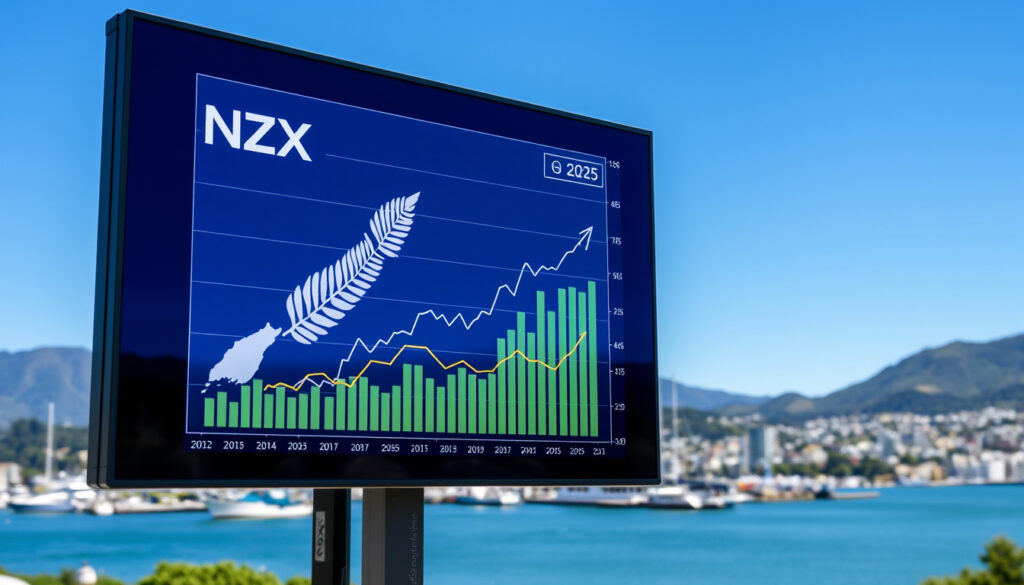
New Zealand Stock Exchange – Complete 2025 Guide
NZX Limited, operating as New Zealand’s Exchange, is the national stock exchange of New Zealand. Headquartered in Wellington, it serves as the primary marketplace for equities, funds, debt securities, derivatives, and energy products traded within the country. The exchange traces its institutional roots to provincial exchanges formed during the 1870s gold rush and today functions as a publicly listed company under the ticker NZX.
What is the New Zealand Stock Exchange?
The New Zealand Stock Exchange, commonly referred to by its trading abbreviation NZX, is the principal securities marketplace operating within New Zealand. The entity behind the exchange is NZX Limited, a publicly incorporated company headquartered in Wellington. It was formally incorporated on December 31, 2002, before adopting the NZX Limited name and demutualizing in 2003, when it listed itself on its own platform and shifted control to external shareholders.
Key facts about the New Zealand Stock Exchange
- Founded: Modern corporate entity incorporated December 31, 2002; NZX Limited structure and listing adopted in 2003.
- Headquarters: Wellington, New Zealand.
- Primary Markets: NZSX (Main Board equities), NZDX (Debt Market), NZCX (Equity Derivatives), and the SGX-NZX Dairy Derivatives platform.
- Own Market Capitalization: Approximately NZ$476.38 million as of August 2025, with roughly 328.54 million shares outstanding.
- Revenue (trailing twelve months): NZ$120.76 million; net income of approximately NZ$25.49 million.
- Benchmark Index: The S&P/NZX 50 Index tracks the top 50 listed companies by liquidity and market capitalization.
- Workforce: Approximately 319 employees as of recent reporting periods.
| Fact | Details |
|---|---|
| Official Name | NZX Limited, trading as New Zealand’s Exchange |
| Ticker Symbol | NZX (listed on NZSX; dual-listed on ASX) |
| Incorporation Date | December 31, 2002 |
| Headquarters | Wellington, New Zealand |
| Core Revenue Segments | Markets, Funds Management, Wealth Technologies |
| Regulatory Supervisor | Financial Markets Authority (FMA) |
| Market Operator | NZ RegCo (NZX Regulation) |
| Employees | Approximately 319 |
How Does the NZX Operate?
NZX operates multiple distinct trading platforms, each serving a different segment of the New Zealand financial markets. The exchange’s core functions span trading, clearing, settlement, market data provision, and infrastructure services for securities, derivatives, energy, and wealth technologies. Revenue is primarily driven by the Markets segment, supplemented by Funds Management and Wealth Technologies activities.
NZX Trading Hours
Trading sessions on NZX operate in New Zealand Standard Time (NZST). Standard market hours run from 10:00 AM to 4:00 PM on business days. Specific derivative products may have adjusted windows—for example, the newly launching S&P/NZX 20 Index Futures are slated to begin trading on April 28, 2026, with hours that may differ from standard equity sessions. Investors are advised to consult the official NZX website for the most current schedule before placing trades.
Markets and Platforms
- NZX Main Board (NZSX): The primary equity listing venue for publicly traded companies.
- NZX Debt Market (NZDX): Handles fixed-income securities including bonds and other debt instruments.
- NZX Equity Derivatives (NZCX): Offers futures and options products, with expansion underway through the upcoming S&P/NZX 20 Index Futures.
- NZX Dairy Derivatives (SGX-NZX): A commodity derivatives platform developed in partnership with Singapore Exchange, serving the dairy sector.
- Fonterra Shareholders’ Market: A specialized platform facilitating trading in shares of the dairy cooperative Fonterra.
NZX operates under the supervision of the Financial Markets Authority (FMA), New Zealand’s independent financial regulator. Day-to-day listing rule enforcement and market integrity monitoring are carried out by NZ RegCo, a dedicated regulatory division of NZX. This two-tier structure is designed to maintain investor confidence and compliance with national securities law.
Who Regulates the New Zealand Stock Exchange?
The Financial Markets Authority (FMA) serves as the overarching regulator for New Zealand’s financial markets, including NZX. The FMA enforces securities legislation, licenses market participants, and oversees investor protection measures. Within the exchange itself, NZ RegCo handles the practical application of listing rules and monitors trading activity to detect irregularities and maintain orderly markets.
What Companies Are Listed on NZX?
NZX hosts a range of listed companies spanning sectors such as agriculture, healthcare, infrastructure, retail, and professional services. The exchange’s own shares also trade on NZSX under the ticker NZX, with approximately 328.54 million shares outstanding. Recent listings activity has included proposals from entities such as Accordant Group Limited (AGL), anticipated on the Main Board on April 17, 2026, and Property for Industry Limited (PFI), expected on the Debt Market on April 14, 2026.
The S&P/NZX 50 Index and Other Indices
The S&P/NZX 50 Index serves as the benchmark for New Zealand’s equity market, tracking the 50 most liquid companies by market capitalization and trading activity. It is used as the underlying reference for futures contracts and provides a snapshot of the overall performance of New Zealand’s listed equity market. Additional indices include the NZX All Index (NZCI), which offers broader market coverage and historical data for analytical purposes.
As of August 2025, NZX’s own market capitalization stood at approximately NZ$476.38 million. The broader New Zealand stock market represents a small but developed market with total capitalization supporting local firms and capital formation. While precise aggregate market cap figures for all listed securities are not publicly specified in current reporting, the exchange remains a meaningful contributor to New Zealand’s capital markets ecosystem.
Notable Listed Companies
Active companies featured in recent exchange announcements include Summerset Group Holdings (SUM), Freightways (FRW), Scales Corporation (SCL), and KMD Brands (KMD), among others. These entities represent the diverse mix of domestic businesses that rely on NZX for equity capital raising and public trading infrastructure.
How Do I Buy Shares on the NZX?
Participating in the New Zealand Stock Exchange requires working through a licensed NZX Participant—typically a brokerage firm or online trading platform authorized to execute orders on behalf of investors. Retail investors can access NZX markets through online brokers offering equities, exchange-traded funds (ETFs), and other listed securities.
Steps to Begin Trading
- Choose a licensed broker: Select an NZX Participant firm registered to trade on New Zealand markets. Many brokers operate both full-service and online-only models.
- Open and fund an account: Complete the account opening process, verify your identity as required by regulations, and deposit funds into your trading account.
- Place orders: Use the broker’s trading platform to search for listed securities by ticker or company name and submit buy orders through the NZSX platform.
- Monitor and manage: Track your portfolio performance using real-time quotes and data tools provided by the broker or through NZX’s market data offerings.
NZX provides real-time quotes, data products, and analytical tools for market participants. Broker platforms typically integrate these feeds to offer investors up-to-date pricing, order book visibility, and historical performance data for securities listed across NZX markets.
What Is the History of NZX?
The origins of the New Zealand Stock Exchange reach back to the 1870s gold rush, when gold mining centers across the country functioned as de facto financial hubs, each operating their own informal exchange for trading mining shares. As the economy matured, the need for coordination across these regional centers became apparent.
The Path to a National Exchange
In 1915, the Stock Exchange Association of New Zealand was formed to bring coherence and standardization to the country’s fragmented exchange activities. The organization evolved over the following decades, eventually gaining national broker status in 1983 and adopting the formal name New Zealand Stock Exchange. The market crash of 1987 triggered a period of significant reform, resulting in stronger governance structures, stricter listing requirements, and mandatory broker education programs.
NZX Limited: From Mutual to Public Company
A defining turning point came in 2002 when NZX elected its first formal board and appointed a chief executive. In 2003, the organization underwent demutualization—converting from a member-owned mutual to a publicly listed company. NZX listed its own shares on the exchange it operates, transferring ownership to external shareholders and aligning incentives with broader market participants. The exchange also secured a dual listing on the Australian Securities Exchange, further expanding its reach and investor base.
NZX Limited itself is listed on the Australian Securities Exchange (ASX) alongside its primary New Zealand listing. However, the two exchanges operate independently under separate regulatory frameworks. The ASX is self-listed, self-regulated, and supervised by the Australian Securities and Investments Commission (ASIC). NZX operates under New Zealand’s FMA, reflecting the distinct regulatory jurisdictions of each country.
Timeline of Key Milestones
- 1870s: Regional exchanges emerge in gold mining centers, each facilitating trade in mining shares and local financial instruments.
- 1915: The Stock Exchange Association of New Zealand is formed, coordinating provincial exchanges under a national framework.
- 1983: The organization is officially renamed the New Zealand Stock Exchange and granted national broker status.
- 1987: The market crash prompts comprehensive governance reforms, including stricter listing rules and mandatory broker education.
- 2002: NZX elects its inaugural board and appoints its first chief executive officer.
- 2003: Demutualization completed; NZX Limited lists on its own platform and becomes a shareholder-controlled entity.
- 2010s–present: Expansion of debt markets, dairy derivatives partnerships, and the development of equity derivatives platforms including upcoming index futures products.
What Remains Established and What Is Unclear
| Established | Uncertain or Undefined |
|---|---|
| NZX is headquartered in Wellington and incorporated as NZX Limited in 2002. | Precise aggregate market capitalization of all securities listed on NZX is not publicly disclosed. |
| The exchange is regulated by the FMA, with operational oversight by NZ RegCo. | Future expansion plans or specific timelines for new derivative products beyond the April 2026 S&P/NZX 20 Index Futures launch are not publicly confirmed. |
| NZX operates five primary market platforms: NZSX, NZDX, NZCX, SGX-NZX Dairy Derivatives, and the Fonterra Shareholders’ Market. | The exact number of listed companies is not consistently reported across all platforms and may change with new listings and delistings. |
| NZX’s own market cap was approximately NZ$476.38 million as of August 2025, with trailing twelve-month revenue of NZ$120.76 million. | Long-term financial projections or growth targets for NZX’s three operating segments are not publicly available. |
| The S&P/NZX 50 Index is the benchmark for New Zealand’s equity market performance. | Specific weightings or sector composition breakdowns beyond general index methodology descriptions are not consistently published. |
| NZX has approximately 319 employees and generated NZ$90.58 million in revenue in 2022. | Detailed employee distribution across the Markets, Funds Management, and Wealth Technologies segments is not publicly disclosed. |
The Role of NZX in New Zealand’s Economy
NZX plays a central role in channeling capital toward New Zealand’s domestic economy. As the nation’s primary marketplace for securities, the exchange provides companies of all sizes with access to equity and debt capital, supporting expansion, innovation, and employment across multiple sectors. The dairy derivatives market, operated in partnership with Singapore Exchange, reflects New Zealand’s competitive advantage in agricultural exports and allows global participants to hedge commodity price risk tied to dairy markets.
The exchange’s relationship with the Australian Securities Exchange adds a layer of cross-market exposure for investors seeking broader Pacific-region diversification. NZX Limited’s dual listing on ASX means that its own shares are accessible to Australian and international investors, reinforcing capital flow linkages between the two markets.
Key Sources and Regulatory References
“The Financial Markets Authority (FMA) is New Zealand’s main financial regulator, overseeing NZX’s compliance with securities laws, licensing market participants, and protecting investors.”
— Financial Markets Authority (FMA), New Zealand
“NZX markets operate in New Zealand Standard Time (NZST), typically 10:00 AM to 4:00 PM on business days, providing real-time quotes, data products, and supporting capital raising across multiple asset classes.”
— NZX Official Market Documentation
“ASX dwarfs NZX in size, ranking among global top exchanges, while NZX maintains a focused, efficient role serving New Zealand’s developed but comparatively smaller domestic capital market.”
— Industry Comparative Analysis, IBISWorld
Summary
The New Zealand Stock Exchange, operating as NZX Limited, is the cornerstone of New Zealand’s capital markets. From its humble beginnings in 1870s gold rush exchanges to its modern incarnation as a self-listed, shareholder-controlled entity, NZX has grown to serve as a regulated, multi-platform marketplace spanning equities, debt, and derivatives. Governed by the Financial Markets Authority and operating through licensed broker participants, it offers investors access to domestic companies across diverse sectors, anchored by the S&P/NZX 50 Index. For those interested in exploring personal finance calculations relevant to New Zealand income, the Take Home Pay Calculator NZ provides useful tools for wage and salary planning. Understanding how the exchange functions and what it offers can help prospective investors and curious readers alike grasp the mechanics of New Zealand’s financial landscape. For broader context on celebrity financial landscapes, readers may also find the Charlie Sheen Net Worth overview informative.
Frequently Asked Questions
What is NZX?
NZX stands for New Zealand Exchange Limited, the national stock exchange headquartered in Wellington. It operates platforms for trading equities, debt, derivatives, and other securities in New Zealand.
Where is NZX located?
NZX is headquartered in Wellington, New Zealand. The entity was incorporated on December 31, 2002, and operates as a publicly listed company.
Who regulates the New Zealand Stock Exchange?
The Financial Markets Authority (FMA) serves as the overarching regulator. Within the exchange, NZ RegCo handles day-to-day listing rule enforcement and market integrity.
What are the main NZX indices?
The primary index is the S&P/NZX 50 Index, which tracks the top 50 companies by liquidity and market capitalization. Additional indices include the NZX All Index (NZCI) for broader market coverage.
How do I buy shares on the NZX?
Investors must open an account with a licensed NZX Participant (broker), fund the account, and place buy orders through the broker’s trading platform for securities listed on NZX markets.
What is NZX market capitalization?
As of August 2025, NZX’s own market capitalization was approximately NZ$476.38 million, with roughly 328.54 million shares outstanding.
Is NZX part of ASX?
NZX and ASX are separate exchanges operating under different regulatory frameworks. NZX Limited itself is dual-listed on ASX alongside its primary NZSX listing, but the two exchanges are independently operated and supervised by their respective national regulators.
What companies are listed on NZX?
NZX hosts companies across sectors including agriculture, healthcare, retail, and infrastructure. Recent listings activity has included entities such as Summerset Group Holdings, Freightways, Scales Corporation, and KMD Brands.
What are NZX trading hours?
Standard trading runs from 10:00 AM to 4:00 PM NZST on business days. Hours may vary for specific derivative products, and investors should consult official NZX schedules for accurate times.
What is the history of the New Zealand Stock Exchange?
NZX traces its origins to informal exchanges during the 1870s gold rush. It was formally coordinated in 1915 through the Stock Exchange Association of New Zealand, evolved into the New Zealand Stock Exchange in 1983, and restructured as NZX Limited in 2003 through demutualization and self-listing.
More related posts
 Hamilton to Auckland Bus: Timetables, Fares & Travel Options
 Patagonia Black Hole Duffel 40L Review: Carry-On Tested
 Ice Ice Baby Timaru: Menu, Hours & Delivery on Stafford
 Australian Open Prize Money 2026: Winner & Breakdown
 What Time is the All Blacks Game? Kickoff Times & TV Guide
 Momentos by the Lake Queenstown: Menu, Reviews & Tips
 Spelling Bee Game Online: Best Free Options and How to Play
 Inter Miami vs Orlando City: Results, Lineups, Rivalry