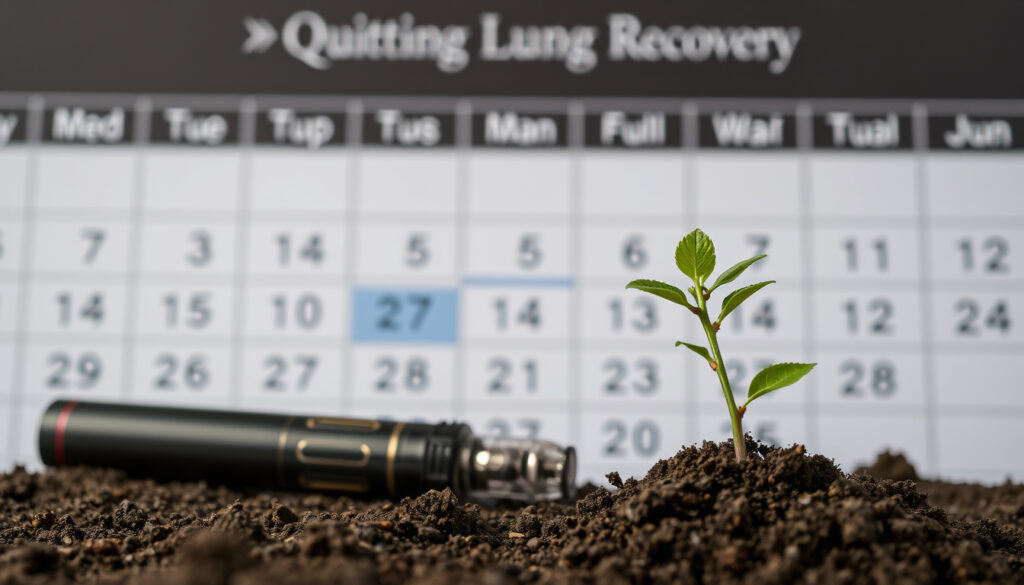
How to Quit Vaping: Withdrawal Timeline & Lung Recovery
Anyone who’s tried to put down a vape for more than a day already knows: this isn’t just “giving something up.” It’s a battle against nicotine, habit, and a dozen tiny triggers wired into your daily routine. The good news is that public health agencies like the NHS (UK’s public health authority) have built a clear, step-based system to help you quit — and it works far better than raw willpower.
Nicotine withdrawal peaks at: 72 hours after the last vape ·
Most withdrawal symptoms resolve within: 2 to 4 weeks ·
Lung cilia begin to recover within: 1 to 9 months ·
Lung healing after quitting vaping can take: up to 5 years
Quick snapshot
- Nicotine withdrawal peaks 72 hours after last use (NHS Better Health)
- NRT doubles quit success rates (NHS Better Health)
- Lungs begin clearing mucus within weeks (NHS 111 Wales)
- Exact lung-recovery timeline after vaping only (vs smoking) is not separately measured
- Whether occasional use (e.g., 2 puffs per day) causes measurable harm is not well studied
- Withdrawal peaks: days 1–3 (NHS Better Health)
- Physical symptoms resolve: 2–4 weeks (NHS Better Health)
- Lung cilia regrow: 1–9 months (Avon and Wiltshire NHS Trust)
- NHS offers free local stop-smoking services with weekly support (NHS)
- Varenicline (stop-smoking pill) being rolled out by NHS England (NHS England)
Five key facts about quitting vaping, one pattern: the worst of withdrawal passes quickly, but full lung healing takes years.
| Milestone | Timeline | Source |
|---|---|---|
| Nicotine withdrawal peak | 72 hours | NHS Better Health |
| Withdrawal resolution | 2–4 weeks | NHS Better Health |
| Lung cilia recovery | 1–9 months | Avon and Wiltshire NHS Trust |
| Full lung healing | Up to 5 years | Avon and Wiltshire NHS Trust |
| NRT success rate improvement | 2x vs. cold turkey | NHS Better Health |
What is the best way of quitting vaping?
Set a quit date and lower nicotine gradually
The NHS (UK’s public health authority) recommends picking a specific quit date — preferably a low-stress day — and then reducing your nicotine strength stepwise over several weeks. Going from 20 mg/ml to 10 mg/ml, then to 6 mg/ml, then 3 mg/ml gives your brain time to adjust.
Use nicotine replacement therapy (NRT) like patches or gum
The NHS says Nicorette QuickMist is currently the only approved nicotine replacement therapy for quitting vaping in the UK. NHS guidance for nicotine replacement therapies recommends using them for about 12 weeks, or longer if needed to prevent relapse. NRT works by providing a steady, low dose of nicotine without the harmful chemicals in vape aerosol — doubling your chances of quitting compared to going cold turkey.
Find new coping mechanisms to replace the habit
Vaping is as much a hand-to-mouth ritual as it is a nicotine delivery system. The NHS suggests replacing that ritual with alternatives: sugar-free gum, crunchy vegetables like carrot sticks, hand fidgets, or deep breathing exercises. NHS guidance also recommends changing your routines — if you always vaped while driving, keep a bottle of water in the cup holder instead.
Smash or recycle your device
The NHS advises physically removing temptation: recycle your vape kit at a local collection point or dispose of pods and chargers. Having a working device nearby is a known relapse trigger.
A vaper who uses NRT and swaps the hand-to-mouth habit faces two distinct battles — chemical and psychological — with a weapon for each. Those who rely on willpower alone fight both at once, which is why NHS data shows NRT roughly doubles success rates.
How long does vape withdrawal last?
Timeline of nicotine withdrawal symptoms
The NHS (UK’s public health authority) lists common withdrawal symptoms after quitting vaping: cravings, irritability, low mood, trouble concentrating, increased hunger, and sleep difficulty. These symptoms follow a predictable timeline.
- Days 1–3: Cravings peak as nicotine clears your system. The NHS says symptoms are usually strongest in the first week, especially the first 3 days.
- Weeks 2–4: Most physical withdrawal symptoms resolve. The NHS states nicotine withdrawal symptoms usually last 3 to 4 weeks on average.
- Months 2+: Psychological cravings — triggered by people, places, or stress — can persist for months. The NHS notes that some people may feel them for a few months.
The worst of withdrawal lasts only 72 hours. The NHS says that after 24 hours without smoking (or vaping), carbon monoxide leaves the body and lungs start to clear. But psychological cravings — the ones that hit when you’re stressed or bored — can linger for months.
The pattern: the physical battle is short, but the mental game requires long-term planning.
What can I replace vaping with?
Healthy substitutes: sugar-free gum, crunchy vegetables
The NHS recommends keeping your hands and mouth busy with sugar-free gum, carrot sticks, or celery. The crunching mimics the sensation of hitting a vape.
Behavioral replacements: hand fidgets, deep breathing
NHS guidance suggests deep breathing exercises during craving spikes, and hand fidgets — a small object to roll between your fingers — to occupy the motor habit. The NHS says changing your routines is key: if you always vaped at your desk, take a 2-minute walk instead.
Nicotine replacements: gum, lozenges, patches
The NHS (UK’s public health authority) states that nicotine replacement therapies like patches, gum, and lozenges deliver a steady dose while you break the vaping habit. The recommended treatment duration is 12 weeks, though some people continue for longer to prevent relapse.
Will my lungs heal if I stop vaping?
What happens to lungs after quitting vaping
When you stop inhaling vape aerosol, your lungs begin a repair process that happens in stages. The NHS 111 Wales (Welsh NHS service) provides a smoke-free timeline that applies to vaping as well: 24 hours after quitting, carbon monoxide leaves the body and lungs start clearing debris.
Timeline of lung recovery: 1–12 months
- 1 week: Nicotine levels drop; cravings intensify but physical healing begins.
- 2–4 weeks: Most withdrawal symptoms end. Lung function starts improving.
- 1–9 months: Avon and Wiltshire NHS Trust states that after 9 months without smoking, breathing usually improves because the lungs work more effectively.
- 1 year: Risk of heart disease drops by 50%.
- 5 years: Lung inflammation significantly reduced; long-term healing reduces infection risk.
Cilia regrowth and reduced inflammation
The Avon and Wiltshire NHS Trust (NHS mental health trust) notes that after 12 weeks without smoking, blood flows to the heart and muscles more easily. After 9 months, breathing capacity improves. The tiny hair-like cilia that sweep mucus out of your lungs begin regrowing within 1 to 9 months.
Your lungs don’t just “stop getting worse” — they actively repair. Within weeks of your last vape, mucus clears. Within months, cilia regrow. The trade-off: full recovery takes years, but the most meaningful improvements happen in the first year.
What this means: the body’s repair timeline offers a clear incentive to quit sooner rather than later.
How to quit vaping without withdrawal?
Gradual nicotine reduction plan
The NHS (UK’s public health authority) recommends lowering your nicotine concentration in steps over several weeks. For example, drop from 20 mg/ml to 10 mg/ml for 2 weeks, then to 6 mg/ml, then to 3 mg/ml, then to zero. Each step gives your brain time to adjust without triggering severe withdrawal.
Use NRT to manage cravings
NHS guidance for nicotine replacement therapies recommends using them for about 12 weeks. Nicorette QuickMist is currently the only approved NRT for quitting vaping in the UK, according to NHS guidance. NRT patches provide stable nicotine levels that prevent the spikes and crashes that trigger cravings.
Behavioral strategies to bypass triggers
The NHS advises identifying your personal triggers — the activity, place, or feeling that makes you reach for your vape — and replacing the action. Common swaps: a glass of water instead of a vape during a phone call, a 2-minute walk after meals, or sugar-free gum during a coffee break. The NHS also highlights the quitSTART app as a tool to track progress.
Nicotine withdrawal symptoms are usually strongest in the first week, especially the first 3 days.
NHS Better Health (UK public health authority)
Nicorette QuickMist is currently the only approved nicotine replacement therapy for quitting vaping in the UK.
NHS Better Health (UK public health authority)
After 9 months without smoking, breathing usually improves because the lungs work more effectively.
Avon and Wiltshire NHS Trust (NHS mental health trust)
More related posts
 How Long Is a Dog Pregnant For? Canine Gestation Guide
 Best Fish and Chips in Whangarei: Top Spots & Delivery
 One Tree Hill Auckland: Guide to Hikes, History & Views
 Apple Cider Vinegar NZ – Where to Buy, Best Brands
 What Is a Thermos? Definition, Uses, and Differences Explained
 The Sands Hotel Hokianga: Beachfront, Prices, Menu & Contact
 Patagonia Black Hole Duffel 40L Review: Carry-On Tested
 How Much Days Until Christmas – 257 Days Countdown 2026