One Tree Hill Auckland: Guide to Hikes, History & Views
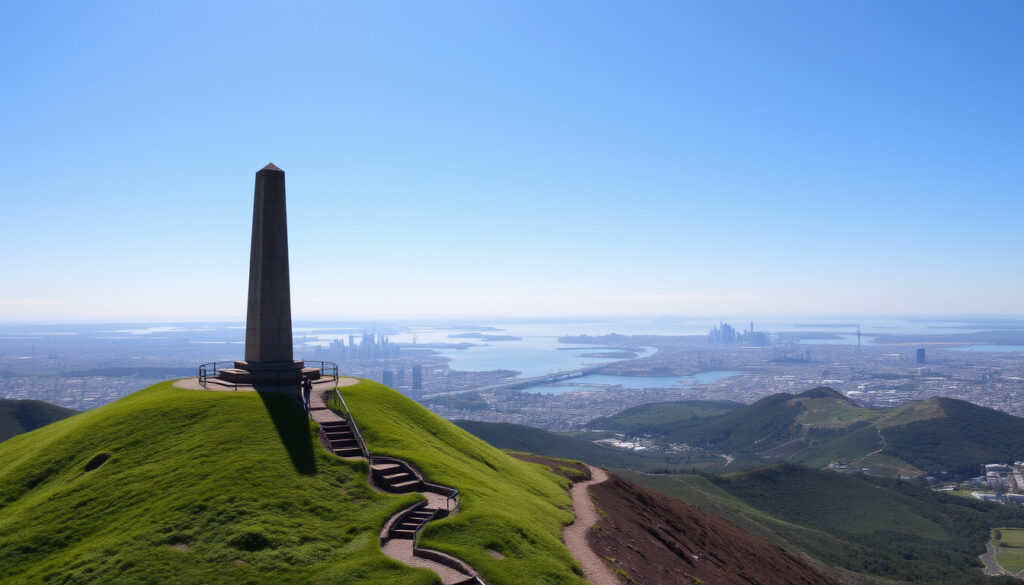
Few places pack as much history into a single climb as One Tree Hill does. Rising just south of Auckland’s city centre, this 182-metre volcanic peak has served as a Māori pā site, a sheep farm, a memorial to early colonial settlers, and the filming location for U2’s iconic concert video. Today, the summit crowned by a granite obelisk is a vehicle-free zone where visitors walk the final stretch themselves. Whether you’re curious about the mountain’s Māori name, the story behind its missing tree, or simply how to get there without a car, this guide covers everything you need before you go.
Height: 182 metres · Location: Auckland, New Zealand · Peak Rank: Second highest in Auckland · Access: Train to Greenlane + 1km walk · Feature: Obelisk at summit
Quick snapshot
- 182-metre volcanic peak (Wanderlog)
- Tūpuna Maunga ancestral mountain (The Road Less Written)
- Obelisk memorial at summit; grave of Sir John Logan Campbell (onX Maps)
- 24/7 free public access (Cornwall Park Official)
- Current parking capacity — no recent vehicle counts published
- Exact walk times vary by fitness — sources report 20 minutes to 2 hours depending on trail choice
- 2020 tihi track construction status — the November 2020 start date has passed; current status unconfirmed by official sources
- 1852: Sacred tōtara chopped down by British settlers (The Road Less Written)
- 2016: Nine replacement trees planted at summit (onX Maps)
- March 2018: Vehicle access to summit closed (Grab Your Wheels)
- November 10: Tihi track construction to begin (year unspecified in available records) (Cornwall Park Official)
- New direct summit route planned via tihi track works (Cornwall Park Official)
- One of nine planted trees will eventually stand alone — continuing the summit’s namesake tradition (Cornwall Park Official)
- Ongoing limited mobility access via code: call 09 301 0101 (Grab Your Wheels)
| Fact | Detail |
|---|---|
| Auckland Peak Height | 182 m (597 ft) |
| Māori Name | Maungakiekie |
| Summit Feature | Obelisk |
| Rank in Auckland | 2nd highest volcanic |
| Public Access | 24/7 free |
| Cornwall Park Hours | 7am–8pm |
| Direct Hike Length | 1.1 miles (1.8 km) |
| Loop Trail (One Tree Hill Loop) | 9.2 km / 2h 5min |
| Easy Walk (One Tree Hill Walk) | 5.14 km / 60 min |
What happened to One Tree Hill, Auckland?
Before European settlement, One Tree Hill was known as Maungakiekie — a fortified Māori pā site where up to 5,000 people once lived in its terraced slopes. The cone-shaped volcano was later donated as public parkland by Sir John Logan Campbell, whose grave sits at the base of the summit obelisk. The obelisk itself commemorates Māori heritage and early colonial history simultaneously.
Volcanic origins
One Tree Hill is an extinct volcanic peak that formed roughly 60,000 years ago, making it one of Auckland’s older volcanic cones. Like its neighbours — Mt Eden, Mt Wellington, and Rangitoto — it is part of the city’s distinctive volcanic field. The summit offers 360-degree views that include Rangitoto Island and every major Auckland volcano. According to onX Maps (hiking trail guide), the peak reaches 182 metres above sea level.
The missing tree story
The hill’s name comes from a single tōtara tree that once stood at the summit. That sacred tree was chopped down by British settlers in 1852, leaving the peak treeless. In 2016, nine new trees were planted in an attempt to restore the summit’s namesake, with plans for the strongest to eventually stand alone. The replacement programme draws directly from Māori tradition — a lone tree symbolising guardianship over the mountain.
Obelisk and modern era
The granite obelisk at the summit dates to the 1870s and serves as a memorial to both Māori and the colonial settlers who shaped modern Auckland. Vehicle access to the summit was closed in March 2018, officially to recognise the maunga as a site of immense cultural and historical significance. Visitors today must walk the final stretch — a move that park authorities say transforms the experience from a scenic drive to a genuine pilgrimage.
Why is it called One Tree Hill, Auckland?
The name directly references the lone tōtara that once marked the summit for centuries. When British settlers felled that sacred tree in 1852, they removed not just a tree but a landmark that local Māori had used for navigation and ceremony. The name stuck even after the tree was gone, becoming the standard English label for Maungakiekie. Today, visitors who reach the summit will see the obelisk and, eventually, the replanted grove — but the original single-tree silhouette remains a story visitors carry up the hill.
Māori name Maungakiekie
The Māori name Maungakiekie translates roughly to “the mountain of the kiekie vine” — a reference to the native plant that once grew abundantly on its slopes. Before European contact, the hill served as a major pā site with sophisticated terraced gardens, defensive structures, and communal spaces. According to The Road Less Written (travel writing publication), the pre-colonial site held “integral significance” to iwi (tribal groups) across the region.
Historical naming
The name “One Tree Hill” entered colonial records after the 1852 felling, when surveyors and early settlers needed English place names for their maps. Unlike many Auckland volcanic cones that took their names from surrounding farms or governors, One Tree Hill earned its label from a single, conspicuous absence — the tree that had defined the summit was gone.
Tree removal event
The 1852 felling remains a sensitive topic. The tōtara was not just a landmark but a marker of tāonga (treasured) significance to Māori. Contemporary discussions around the 2018 vehicle closure and the 2016 tree planting are often framed as acts of reparation — attempts to restore what was lost. The distinction matters: One Tree Hill is not merely a scenic peak but a site of ongoing cultural negotiation.
Is One Tree Hill, Auckland worth visiting?
For visitors who want Auckland’s combination of Māori heritage, volcanic geology, and city panoramas without a multi-hour commitment, One Tree Hill delivers efficiently. The direct summit hike takes roughly 20 minutes on a paved path, making it accessible for families, pushchairs, and visitors with limited time. Unlike Mt Eden’s dramatic crater, One Tree Hill sits within a larger park with farm animals, picnic areas, and a visitor centre — features that make it worth a half-day visit rather than a quick stop.
Panoramic city views
From the summit, you can see Rangitoto Island, the Waitematā Harbour, the Sky Tower, and most of Auckland’s volcanic field. onX Maps notes the summit offers 360-degree views that are “unbeatable” for a city-adjacent hike. On a clear day, photographers and casual walkers alike find the vista worth the short climb.
Cultural significance
One Tree Hill carries layers of meaning that most Auckland peaks lack. A pre-colonial pā site, a colonial gift of land, a memorial obelisk, and a contemporary vehicle closure that restored the mountain to pedestrian access — each layer adds context that enriches the walk. The 2018 closure specifically cited Māori cultural and historical significance as the reason, making the summit experience a different kind of journey than simply reaching a high point.
Pros and cons
Upsides
- Free entry, 24/7 access year-round
- Short 20-minute summit hike on paved path
- 360-degree Auckland views including Rangitoto
- Farm animals, Huia Lodge visitor centre, and picnic facilities on site
- Accessible for families, pushchairs, and limited mobility visitors
- Cornwall Park integrates into Auckland’s Coast to Coast Walk
Downsides
- Vehicle access to summit closed since March 2018
- Parking fills up on weekends and public holidays
- Limited mobility access requires advance phone call for barrier code
- Tihi track construction may affect summit route at certain times
- No café on the volcanic cone itself — closest options in Remuera or Greenlane
How long does it take to walk up One Tree Hill in Auckland?
Three distinct trail options serve different priorities: the short direct summit hike for a quick payoff, the moderate One Tree Hill Walk loop for families, and the longer One Tree Hill Loop for fitness-oriented hikers. All trails start from Cornwall Park, and none require park fees.
Trail options and duration
- Direct summit hike: 1.1 miles (1.8 km) out-and-back with 252 feet of elevation gain. Takes approximately 20–25 minutes at a brisk pace (onX Maps).
- One Tree Hill Walk loop: 5.14 km, rated easy, takes about 60 minutes. Suitable for all ages including wheelchairs with a few steps along the route (Freewalks.nz).
- One Tree Hill Loop: 9.2 km, medium-grade looped trail with 155 m elevation gain. Takes approximately 2 hours 5 minutes (Hiiker).
Difficulty level
The direct summit path is paved and not steep, making it manageable for children and visitors with moderate fitness. The One Tree Hill Walk loop is rated easy with a few steps. The full One Tree Hill Loop adds moderate elevation and longer distance, better suited for regular walkers. No technical scrambling or specialised gear is required for any route.
Step-by-step access
- Arrive at Cornwall Park via car or public transport
- Use Manukau Road entrance, Olive Grove Road entrance, or Green Lane West entrance for parking
- Follow signs toward the One Tree Hill summit or join the Coast to Coast Walk
- Walk the paved path to the summit obelisk (20 minutes for direct route)
- For tihi track construction periods, use the old summit road from Manukau Road or Olive Grove Road carpark as alternative
Practical tips for One Tree Hill Auckland
Getting to One Tree Hill is straightforward whether you arrive by car or train, and the park’s facilities mean you can extend a quick hike into a half-day visit. Knowing gate hours, parking entrances, and the limited mobility access procedure prevents surprises on arrival.
Parking and opening hours
Cornwall Park gates open from 7am to 8pm on weekdays, weekends, and public holidays, according to Cornwall Park Official (official park authority). Free car parking is available from Green Lane West, Manukau Road, Market Road, and Campbell Road entrances. Parking fills quickly on fine weekends — arriving before 10am improves your chances of a spot near the summit trailheads.
Directions and map
By train: Take any train toward Greenlane or Remuera stations. From Greenlane station, it’s roughly a 15-minute walk southwest along Prince Edward Street and Market Road to the park’s Green Lane West entrance. From Remuera station, the walk is approximately 10 minutes south. By car: Exit the Southern Motorway at Greenlane (exit 451), follow Greenlane East toward the traffic lights, and turn right onto Prince Edward Street. The Cornwall Park gates appear within minutes.
Nearby restaurants
There is no café on the volcanic cone itself. The closest dining options are in the Remuera and Greenlane village strips, both within a 10-minute drive or a 20-minute walk from the park’s Manukau Road entrance. For visitors combining One Tree Hill with a broader Auckland day, the Stardome Observatory adjacent to the park offers a separate attraction for evening visits.
Vehicle access to the summit closed in March 2018, and visitors with limited mobility must call 09 301 0101 in advance for a barrier code. If you are visiting with someone who cannot walk the final stretch, plan ahead — the phone code is not a walk-in service.
Timeline
| Period | Event |
|---|---|
| Pre-1852 | Lone tōtara tree stands at summit, used for navigation and ceremony by Māori |
| 1852 | Sacred tōtara chopped down by British settlers (The Road Less Written) |
| 1870s | Granite obelisk constructed as memorial; Sir John Logan Campbell’s grave added at summit |
| 2016 | Nine replacement trees planted at summit (onX Maps) |
| March 2018 | Vehicle access to summit closed to recognise cultural significance to Māori (Grab Your Wheels) |
What people say
“One Tree Hill gives you nature, history, and a view of every part of Auckland in just one walk. It’s the perfect micro-adventure.”
— Sandra, Contributor, Freewalks.nz
“Vehicle access closed ‘to recognise the maunga (mountain) as a site of immense cultural and historical significance.'”
— Park authorities, official statement (Grab Your Wheels)
The 2016 tree planting programme and the 2018 vehicle closure reflect a broader shift in how Auckland treats its volcanic cones — prioritising pedestrian access and cultural restoration over convenience. Visitors arriving today experience a mountain in active recovery rather than a static landmark.
For visitors arriving from the CBD or airport, One Tree Hill sits comfortably between a quick outing and a half-day commitment. The short 20-minute summit hike, free entry, and 24/7 access make it one of Auckland’s most practical volcanic experiences — and the layered history of Māori pā, colonial land gift, and contemporary cultural restoration gives that short climb a weight that a longer trail through an unmarked peak simply cannot match. Whether you choose the direct route or the longer loop, the obelisk at the top delivers the same claim: Auckland’s second-highest volcanic peak, earned on foot.
Related reading: Brick Bay Sculpture Trail · Milford Sound Scenic Flights
Frequently asked questions
What are the best views from One Tree Hill Auckland?
The summit offers 360-degree views that include Rangitoto Island, the Waitematā Harbour, the Sky Tower, and most of Auckland’s volcanic field. Clear days provide the sharpest panoramas, and early morning visits tend to have fewer crowds and better light for photography.
How to reach One Tree Hill Auckland by public transport?
Take a train to Greenlane or Remuera stations. From Greenlane, walk approximately 15 minutes southwest to the park’s Green Lane West entrance. From Remuera, the walk south takes roughly 10 minutes. Both stations are on Auckland’s rail network and reachable from Britomart in the CBD.
Is there parking at One Tree Hill Auckland?
Free car parking is available from Green Lane West, Manukau Road, Market Road, and Campbell Road entrances. Spaces fill quickly on weekends and public holidays. The Manukau Road entrance is closest to the summit trailhead. Cornwall Park gates open from 7am to 8pm daily.
What nearby attractions pair with One Tree Hill?
The Stardome Observatory is adjacent to Cornwall Park and makes a natural pair for evening visits. The park itself has Huia Lodge visitor centre, farm animals, picnic areas, and playgrounds. One Tree Hill also connects to Auckland’s Coast to Coast Walk route via Manukau Road and Campbell Crescent.
When is the best time to visit One Tree Hill Auckland?
Weekday mornings offer the lightest crowds and easiest parking. Fine weekends draw families and photographers. Summer (December to February) provides the longest daylight hours for extended hikes but also the heaviest park usage. Spring brings wildflowers to Cornwall Park’s meadows.
Are there facilities at One Tree Hill summit?
The summit has the obelisk memorial and the grave of Sir John Logan Campbell. Picnic tables, barbecues, and a playground are available in Cornwall Park below the summit but not on the volcanic cone itself. Huia Lodge inside the park offers AED equipment and ecological information.
What is the U2 connection to One Tree Hill Auckland?
Irish rock band U2 filmed their 1989 concert at One Tree Hill. The concert was a major event in the band’s career and cemented the hill’s international recognition beyond its Māori and geological significance. The filming took place on the upper slopes of the volcanic cone.
More related posts
 Mortgage Loan Switching New High: How to Save Thou and in Ireland
 Galaxy Watch 8 Classic: Worth It? Specs, Price, and Comparison
 Bryce Dallas Howard Movies: Filmography and Career
 Ear Wax Removal Near Me: Costs, Methods & Local Clinics
 We Can Be Heroes: Review, Sequel, Age Rating & Guide
 Casinorankboard.com nz online casino: Legit, safe, real money
 UK Daily Mail Online: Guide to the News Site and App
 JB Hi-Fi Botany – Hours, Location, Reviews and Services