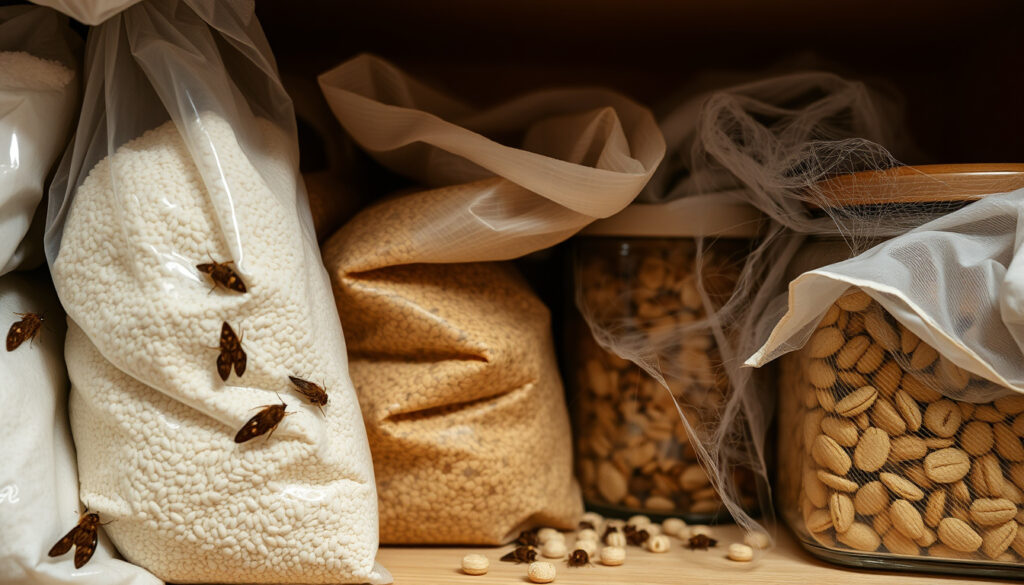
What Is a Pantry Moth? Identification, Causes & Removal Guide
You open a box of cereal and a tiny moth flutters out — that’s the pantry moth, one of the most common kitchen pests across the United States. This guide shows you exactly what they are, what draws them in, how to spot an infestation, and the most effective way to break their life cycle so they don’t keep coming back.
Scientific name: Plodia interpunctella ·
Adult size: 8–10 mm (0.3–0.4 in) ·
Eggs per female: 100–400 ·
Lifespan: 1–3 months
Quick snapshot
- Small grayish-brown moth, 8–10 mm long (Clemson Cooperative Extension (home pest management))
- Also called Indianmeal moth, flour moth, grain moth (Wikipedia (taxonomy reference))
- Larvae feed on grains, flour, dried fruits, pet food (UF/IFAS Ask IFAS (entomology research))
- Adults fly erratically, often at night (Catchmaster (pest control manufacturer))
- Adult moths flying in kitchen, especially near pantry (Professional Pest Manager (pest control industry))
- Silken webs on food packages (University of Wisconsin Horticulture Extension)
- Larvae in flour, cereal, or pet food (National Pesticide Information Center (U.S. EPA-affiliated resource))
- Small holes in packaging (TERRO (pest control products))
- Eggs hatch in 3–8 days depending on temperature (UF/IFAS Ask IFAS)
- Larvae feed 6–8 weeks, then pupate (Clemson Cooperative Extension)
- Pupal stage lasts 15–20 days (University of Wisconsin Horticulture Extension)
- Complete cycle: 27 days to 300 days (Catchmaster (pest control manufacturer))
- Discard infested food immediately (Professional Pest Manager (pest control industry))
- Vacuum and wash all pantry surfaces (TERRO (pest control products))
- Store new food in sealed glass or plastic containers (Wikipedia (taxonomy reference))
- Use pheromone traps to monitor adults (Catchmaster (pest control manufacturer))
Six facts cover the basics: this pest is tiny, prolific, and lives almost entirely inside food packaging.
| Attribute | Value |
|---|---|
| Common Name | Pantry moth (also Indianmeal moth, flour moth) |
| Scientific Name | Plodia interpunctella |
| Adult Size | 8–10 mm |
| Color | Grayish-brown with coppery bands on wings |
| Diet | Grains, flour, seeds, dried fruits, pet food |
| Lifespan | 1–3 months |
The real damage comes from the larvae — not the flying adults. Adult moths don’t eat stored food; their sole job is to mate and lay eggs. Break the larval cycle and you break the infestation.
What is a pantry moth in the house?
What does a pantry moth look like?
- Adults are 8–10 mm long with grayish-brown forewings and a coppery band across the middle (Clemson Cooperative Extension (home pest management))
- Larvae are white or cream-colored with a brown head, up to 13 mm long (UF/IFAS Ask IFAS (entomology research))
- Eggs are tiny, oval, and almost invisible to the naked eye (Catchmaster (pest control manufacturer))
What is the scientific name for pantry moths?
The scientific name is Plodia interpunctella. It belongs to the family Pyralidae. Common names include Indian meal moth, weevil moth, flour moth, and grain moth (Wikipedia (taxonomy reference)).
The implication: knowing the exact species helps you target removal techniques that work specifically for this moth.
What are pantry moths most attracted to?
Why do pantry moths infest kitchens?
- They hitchhike in on already infested food products from grocery stores or warehouses (Clemson Cooperative Extension)
- Females are drawn to food smells and lay eggs directly on or near susceptible food (UF/IFAS Ask IFAS)
- Kitchens offer warmth, moisture, and abundant hiding spots
What foods attract pantry moths?
- Grains: flour, cornmeal, oatmeal, rice, pasta
- Seeds and nuts: birdseed, sunflower seeds, peanuts
- Dried fruits: raisins, apricots, prunes
- Pet food and birdseed (Professional Pest Manager (pest control industry))
- Chocolate, spices, and powdered milk are also targets (University of Wisconsin Horticulture Extension)
Pantry moth larvae can chew through thin plastic and cardboard packaging. A sealed bag from the store is not automatically safe — inspect every package before bringing it home.
The pattern: these moths are opportunistic — they will infest any edible dry good that isn’t sealed in metal or glass.
How do you tell if you have pantry moths?
Signs of a pantry moth infestation
- Small moths flying around the kitchen, especially at dusk or when cupboards are opened
- Silken webbing — a telltale sign of larvae activity — on the surface of flour, cereal, or inside packages (Clemson Cooperative Extension)
- Larvae crawling along shelves or walls
- Small holes in food packaging (larvae chew their way out to pupate)
How to find pantry moth eggs and larvae
- Check the folds of paper packaging, under box flaps, and inside crevices
- Examine flour, cereal, and pet food by pouring onto a white surface — larvae are pale and move slowly
- Look for tiny white eggs (less than 1 mm) on the inside of lids or near seams (Catchmaster (pest control manufacturer))
What this means: early detection requires inspecting the package itself, not just the pantry floor.
How do you get rid of pantry moths?
How to clean infested pantry
- Discard all infested food — do not try to salvage items with visible larvae or webbing (UF/IFAS Ask IFAS)
- Vacuum shelves, cracks, corners, and under appliances — then dispose of the vacuum bag outside (Clemson Cooperative Extension)
- Wash all surfaces with hot, soapy water or a 50/50 vinegar and water solution
- Store new food in airtight containers immediately
What kills pantry moths instantly?
- Heat: washing items at 140°F (60°C) or more kills all life stages
- Freezing: place food in a freezer at 0°F (-18°C) for at least 4 days to kill eggs and larvae (University of Wisconsin Horticulture Extension)
- Pheromone traps: attract and trap adult males, preventing mating (but do not kill larvae or eggs) (TERRO (pest control products))
Natural remedies and traps
- Pheromone traps are the most effective non-toxic monitoring tool (Professional Pest Manager)
- Bay leaves and cloves are commonly suggested repellents, though evidence of effectiveness is limited
- Diatomaceous earth can be dusted in cracks as a desiccant
Adult moths are visible but harmless — the real threat is hidden in your food. A single female can lay up to 400 eggs, meaning a small infestation can explode into a full pantry contamination in weeks if you only target the flying adults.
The catch: cleaning alone won’t work if you leave any food source accessible — the larvae will simply re-establish.
Will pantry moths eventually go away?
Do pantry moths go away on their own?
- No — as long as there is a food source, the population will persist (University of Wisconsin Horticulture Extension)
- Pupae can survive for months in a dormant state
- Without intervention, the cycle continues indefinitely
How to prevent future infestations
- Store all dry goods in airtight glass, metal, or thick plastic containers with tight lids (Clemson Cooperative Extension)
- Freeze new grains for 3–4 days before storing to kill any hidden eggs (UF/IFAS Ask IFAS)
- Buy food in quantities you can use within 2–4 months (Professional Pest Manager)
- Regularly vacuum and wipe down pantry shelves
- Place pheromone traps year-round as an early warning system (TERRO (pest control products))
The implication: prevention is a long-term habit, not a one-time fix.
Clarity check
Confirmed facts
- Pantry moths do not bite humans or pets (UF/IFAS Ask IFAS)
- Larvae can survive freezing temperatures — but freezing at 0°F for 4 days kills them (Clemson Cooperative Extension)
- Adults are strongly attracted to synthetic pheromones used in traps (TERRO)
What’s unclear
- Whether essential oils (bay, clove, lavender) reliably repel pantry moths is not backed by strong evidence
- Ultrasonic devices marketed as pest repellents lack peer-reviewed support for pantry moth control
- The exact combination of temperature and duration needed to guarantee all egg stages are killed in frozen food is not fully standardized
The pattern: the science is solid on confirmed facts, but home remedies still lack rigorous testing.
Expert perspectives
“Pantry moths are a common stored product pest that can infest homes through contaminated food.”
— National Pesticide Information Center (NPIC (U.S. EPA-affiliated resource))
“Alternative common names include weevil moth, pantry moth, flour moth or grain moth.”
— Wikipedia (Wikipedia (taxonomy reference))
“Good sanitation is the best prevention and control for Indian meal moth infestations.”
— Clemson Cooperative Extension (Clemson HGIC (home pest management))
Pantry moths are a persistent problem because they hide where we store food. The infestation doesn’t resolve itself — it requires throwing out contaminated products, thorough cleaning, and switching to sealed containers. For any homeowner, the choice is clear: invest in airtight storage and a $10 pheromone trap, or face an ongoing cycle of contaminated flour and unexpected moth flights every few months.
moth-prevention.com, drkilligans.com, lelaburris.com, terro.com, diypestcontrol.com, moth-prevention.com
Frequently asked questions
Do pantry moths bite?
No. Pantry moths do not bite humans or pets. The larvae feed only on stored food products, not on fabric or skin (UF/IFAS Ask IFAS).
Are pantry moths dangerous to humans?
They are not directly dangerous, but eating food contaminated with larvae or webbing can cause digestive upset. The primary concern is food waste and quality loss (Clemson Cooperative Extension).
What temperature kills pantry moth eggs?
Freezing at 0°F (-18°C) for at least 4 days kills all life stages. Heating to 140°F (60°C) for 20 minutes also works (University of Wisconsin Horticulture Extension).
How long does it take to get rid of pantry moths?
With aggressive cleaning and sealing, you can stop new adults within 2–4 weeks. However, residual pupae may emerge for up to 2 months. Continued trapping is recommended for at least 3 months (Professional Pest Manager).
Can pantry moths live in the refrigerator?
No. Refrigerator temperatures (35–40°F) are too cold for eggs to hatch and larvae to develop. However, adults can survive briefly if they enter a cold area. Freezing is more reliable for killing all stages (TERRO (pest control products)).
Should I call an exterminator for pantry moths?
Usually not necessary. Pantry moths can be eliminated without pesticides by discarding infested food, cleaning thoroughly, and using pheromone traps. Exterminators may apply residual sprays if the infestation has spread to cracks and voids (Catchmaster (pest control manufacturer)).
Do pantry moths fly during the day?
They are most active at dusk and night, but you may see them flying during the day if disturbed. Adults are weak fliers and tend to flutter near food sources (Wikipedia (taxonomy reference)).
More related posts
 NZ Super Pension Rules 2025 Changes & Overseas Guide
 King’s Birthday NZ 2024: Date, Public Holiday & History
 Milford Sound Scenic Flights: Guide, Reviews & Worth It?
 Wine Shop Near Me: Laws, Delivery & Top Shops in Ireland
 Best Time to Visit Japan – Ultimate Seasonal Guide
 Queen Size Mattress NZ: Dimensions and Buying Guide
 Hair Cuts for Boys: Best 2025 Styles, Trends & Tips
 Auckland to Christchurch Flights: Times, Cost & Tips