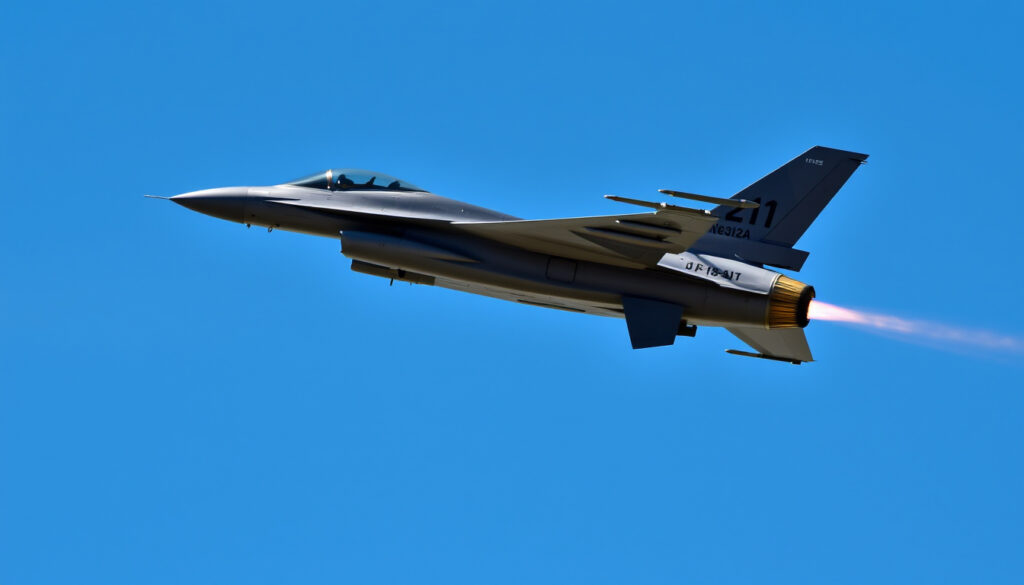
General Dynamics F-16 Fighting Falcon: Specs & Combat Record
There’s a reason the F-16 Fighting Falcon has been flying for nearly five decades—it’s fast, versatile, and has proven itself in combat across the globe. But with newer fighters like the F-35 and fifth-generation designs stealing headlines, this fact-checked article cuts through the noise with a look at its speed, dogfight record, and how it stacks up against modern rivals.
First flight: 1974 ·
Maximum speed: Mach 2.05 (1,500 mph / 2,414 km/h) ·
Combat radius: 340 mi (295 nmi / 550 km) ·
Unit cost (FY98): US$18.8 million (F-16C/D) ·
Number produced: Over 4,600 (as of 2023) ·
Operators: 25+ countries
Quick snapshot
- Top speed: Mach 2.05 at altitude (U.S. Air Force Fact Sheet)
- Entered USAF service in 1978 (Wikipedia (English))
- Over 4,600 units produced as of 2023 (Wikipedia (Spanish))
- Exact number of F-16 air-to-air kills in combat (USAF does not release per-type tally) (MigFlug Combat Statistics)
- Full F-16 loss record in non-US operations — some countries do not publish complete data (Aviation Stack Exchange)
- 1974: First flight of YF-16 prototype (Wikipedia (French))
- 1991: Operation Desert Storm — F-16s flew over 13,000 sorties (U.S. Air Force Fact Sheet)
- Block 70/72 production ongoing for export customers into the 2020s (Wikipedia (Spanish))
- Retirement plans in USAF: F-16 being replaced by F-35A, but hundreds remain in service (U.S. Air Force Fact Sheet)
Six key specs define the F-16’s design philosophy: a lightweight airframe, single engine, bubble canopy, and a 9-g capability that still sets the benchmark for fourth-generation fighters.
| Specification | Value |
|---|---|
| Role | Multirole fighter, air superiority, ground attack |
| Crew | One (F-16A/C) or two (F-16B/D) |
| Length | 49 ft 4 in (15.04 m) |
| Wingspan | 31 ft 0 in (9.45 m) |
| Empty weight | 18,900 lb (8,573 kg) |
| Powerplant | 1 × Pratt & Whitney F100 or General Electric F110 afterburning turbofan |
| Maximum speed | Mach 2.05 (1,500 mph / 2,414 km/h) at altitude |
| Service ceiling | 49,213 ft (15,000 m) |
| Ferry range | More than 2,002 mi (3,222 km) |
| Armament | 1 × M61A1 20mm cannon (500 rounds); external hardpoints for AAMs, bombs, and rockets |
Is the F-16 the best fighter jet in the world?
That question has no single answer, but the F-16’s combat record gives it a strong claim. Unofficial combat statistics summaries attribute roughly 72 to 80 confirmed air-to-air kills to the F-16 with only 1 to 2 air-to-air losses, according to MigFlug Combat Statistics (third-party aggregation). The U.S. Air Force does not publish an official per-type kill tally, but the aircraft’s kill ratio is widely cited as exceeding 60:1.
F-16 combat record and kill ratio
- First major combat: Operation Desert Storm (1991) — F-16s flew over 13,000 sorties (U.S. Air Force Fact Sheet)
- Air-to-air tally: 76 kills, 1 air-to-air loss, 5 losses to ground fire per one analysis (Aviation Stack Exchange (community discussion))
- Overall combat losses: over 300 F-16s lost (mostly to ground fire, not air combat) (Wikipedia (English))
Top contenders for best fighter title
- F-22 Raptor: fifth-generation stealth, thrust vectoring, supercruise (U.S. Air Force)
- Su-57: Russian stealth fighter with supermaneuverability (MigFlug Su-27 page)
- J-20: Chinese fifth-generation fighter with long-range radar (Wikipedia (English))
The F-16’s combat record dwarfs any fifth-generation jet’s, but “best” depends on the mission: for air superiority today, an F-22 or Su-57 outclasses it in stealth and sensor fusion.
The pattern: fourth-generation fighters like the F-16 have the bulk of real-world kills, while stealth fighters dominate in simulated environments. The trade-off is cost—an F-16 costs roughly $18.8 million (FY98) versus $150 million for an F-35.
F-16 vs F-35: speed and overall comparison
The most common comparison pits the F-16 against its planned replacement, the F-35 Lightning II. The gap in speed is significant.
Speed comparison: F-16 vs F-35
- F-16 top speed: Mach 2.05 (1,500 mph / 2,414 km/h) at altitude (U.S. Air Force Fact Sheet)
- F-35 top speed: Mach 1.6 (1,200 mph / 1,931 km/h) (Business Insider (defense reporting))
Which jet is more advanced overall?
The F-35 trades raw speed for stealth and sensor fusion. In early training dogfights against the F-16, the F-35 performed poorly when it lacked mature tactics and software, according to a 2017 Business Insider report. However, the same report notes that later, with updated tactics, the F-35 achieved a 20-to-1 kill ratio against legacy aircraft during Red Flag training.
| Attribute | F-16 Fighting Falcon | F-35 Lightning II |
|---|---|---|
| Max speed | Mach 2.05 | Mach 1.6 |
| Stealth | No (low RCS with external stores) | Full stealth |
| Sensor fusion | Legacy radar (AESA on later blocks) | Advanced DAS and sensor fusion |
| Combat radius | 340 mi (550 km) | ~670 mi (1,080 km) internal fuel |
| Unit cost | ~$18.8M (FY98) | ~$80M+ (F-35A) |
For air forces that rely on speed and energy fighting, the F-16 remains superior. But in a high-threat environment where stealth is survival, the F-35’s sensor fusion and low observability outweigh the speed deficit.
The catch: a pilot’s skill and tactics often matter more than the aircraft’s top speed. The F-16’s 9-g airframe and bubble canopy give it a visual dogfight edge that the F-35, with its limited rear visibility, cannot match.
The F-16 is faster than the F-35 but lacks stealth; the F-35’s electronic warfare and sensor fusion dominate in modern high-threat scenarios.
Is the F-16 better than Russian jets?
Russian fighters like the MiG-29 and Su-27 series were designed specifically to counter Western fighters. The answer depends on whether you’re talking BVR (beyond visual range) or close-in dogfighting.
F-16 vs MiG-29 performance
- MiG-29 has better thrust-to-weight ratio and maneuverability at low speeds (Wikipedia (French))
- F-16 has superior radar and BVR missile capability (AIM-120 AMRAAM) (U.S. Air Force Fact Sheet)
- Helmet-mounted sight and R-73 pairing on MiG-29 improves high-off-boresight combat (Wikipedia (French))
F-16 vs Su-27/30/35 capabilities
- Su-27 top speed: ~Mach 2.35 (1,553 mph) — faster than the F-16 (Military Factory (comparison database))
- Su-27 was designed as an F-15 counterpart, not an F-16 equivalent (MigFlug Su-27 page)
- Su-35 adds thrust vectoring and AESA radar, narrowing the BVR gap with the F-16 (Wikipedia (English))
The trade-off: in a close-range merge, a MiG-29 or Su-35 can out-turn the F-16, but the F-16’s newer radar and AIM-120C/D allow it to engage first from beyond visual range.
Has an F-16 ever lost a dogfight or been shot down?
Yes—and the details matter. The F-16 has lost dogfights in training exercises against F-15s and F/A-18s, and it has suffered over 300 combat losses, though the vast majority were from ground fire.
F-16 dogfight loss history
- Training: F-16s regularly lose to F-15s and F/A-18s in dissimilar air combat training (Aviation Stack Exchange)
- Combat: only 1–2 confirmed air-to-air losses of F-16s (one reportedly to a MiG-29 in 1999) (MigFlug Combat Statistics)
Combat losses of the F-16
- Over 300 F-16s lost in combat operations worldwide (Wikipedia (English))
- Most losses to anti-aircraft artillery and surface-to-air missiles (Wikipedia (English))
- USAF F-16 losses in Desert Storm: 3 lost (all to ground fire) (U.S. Air Force Fact Sheet)
The F-16 has a stellar air-to-air record but a high overall loss rate because it’s used extensively for ground attack. The airframe’s survivability in close air support is lower than that of a dedicated ground-attack platform.
F-16 specifications, speed, and production status
For those who want the raw numbers, here’s the definitive spec sheet and the latest on F-16 production.
General Dynamics F-16 Fighting Falcon top speed
The F-16’s official top speed is Mach 2.05 at altitude, according to the U.S. Air Force Fact Sheet (official military specifications). That’s 1,500 mph (2,414 km/h). The thrust-to-weight ratio is 1.095 when fully loaded, allowing for sustained 9-g turns.
F-16 fighter jet made by which country
The F-16 was designed and manufactured in the United States by General Dynamics (now part of Lockheed Martin). The first flight was in 1974, and it entered USAF service in 1978 (Wikipedia (community-edited encyclopedia)).
Is the F-16 still in production?
Yes. The F-16 Block 70/72 (also called the F-16V Viper) is still being built for export customers. The latest orders include deliveries to Bahrain, Slovakia, and Taiwan through the 2020s (Wikipedia). Lockheed Martin continues to produce the aircraft at its Greenville, South Carolina facility.
| Specification | Value | Source |
|---|---|---|
| Wing loading | 88.3 lb/ft² | Wikipedia |
| Thrust-to-weight ratio | 1.095 | Wikipedia |
| Service ceiling | 49,213 ft (15,000 m) | Wikipedia |
| Maximum takeoff weight | 37,500 lb | U.S. Air Force Fact Sheet |
| Ferry range | More than 2,002 mi | U.S. Air Force Fact Sheet |
| Combat radius | 340 mi (295 nmi / 550 km) | U.S. Air Force Fact Sheet |
| Unit cost (F-16C/D, FY98) | US$18.8 million | Wikipedia |
| Total production (as of 2023) | Over 4,600 | U.S. Air Force Fact Sheet |
The F-16 remains in production for export, with modern variants offering AESA radar and advanced avionics, though the USAF is transitioning to the F-35.
Timeline: Key milestones of the F-16
- 1974 — First flight of the YF-16 prototype (Wikipedia)
- 1978 — Entered service with the U.S. Air Force (U.S. Air Force Fact Sheet)
- 1991 — Operation Desert Storm: F-16s flew over 13,000 sorties (U.S. Air Force Fact Sheet)
- 1993 — Lockheed Martin assumes production from General Dynamics (Wikipedia)
- 2020s — Block 70/72 production ongoing for export customers (Wikipedia)
The implication: the F-16 has outlived its original design lifecycle by decades, largely thanks to continuous upgrades.
What we know and what remains unclear
Confirmed facts
- F-16 top speed is Mach 2.05 at altitude (U.S. Air Force Fact Sheet)
- F-16 entered USAF service in 1978 (Wikipedia)
- Over 4,600 units produced (Wikipedia)
- Armed with M61A1 20mm cannon (500 rounds) (U.S. Air Force Fact Sheet)
- Maximum takeoff weight 37,500 lb (U.S. Air Force Fact Sheet)
What’s unclear
- Exact number of F-16 dogfight wins in combat (USAF does not release per-type kill tally) (MigFlug Combat Statistics)
- F-16 loss record in non-US operations — some countries do not publish full loss data (Aviation Stack Exchange)
- General accuracy of the reported 72–80 air-to-air kills (third-party estimates only) (MigFlug Combat Statistics)
Quotes from the field
The F-16 is a highly maneuverable, combat-proven multirole fighter that combines air-to-air and air-to-ground capabilities in a single-engine design.
— U.S. Air Force Fact Sheet (official military source)
In early training dogfights, the F-35 performed poorly against the F-16 when it lacked mature tactics and software. Later, with updated tactics, it achieved a 20-to-1 kill ratio against legacy aircraft.
The Su-27 was the Soviet counterpart to the F-15 Eagle rather than the F-16, reflecting a heavier air-superiority design lineage.
— MigFlug Su-27 page (specialist aviation site)
The bottom line on the F-16 Fighting Falcon
After five decades of service, the F-16 remains one of the most successful multirole fighters ever built. Its combat record — with over 70 air-to-air kills and only one confirmed loss in air combat — speaks to its effectiveness, even against modern threats. But the aircraft’s vulnerability to ground fire and its lack of stealth mean that for air forces facing integrated air defenses, the F-16 is a daylight fighter that needs electronic warfare support. For nations like Slovakia and Taiwan that are buying Block 70/72s today, the choice is clear: the F-16 offers the best bang for the buck in a fourth-generation fleet, but it must be paired with modern jamming pods and standoff weapons to survive against peer adversaries.
Related reading: **Galaxy Watch 8 Classic: Worth It? Specs, Price, and Comparison**
de.wikipedia.org, popularmechanics.com, youtube.com, ukraine-war-analytics.com
Frequently asked questions
Who makes the F-16 Fighting Falcon?
The F-16 was originally designed and built by General Dynamics. Lockheed Martin assumed production in 1993 and continues to build new variants.
What is the range of the F-16?
Ferry range exceeds 2,002 miles (3,222 km). Combat radius is about 340 miles (550 km) on a typical air-to-ground mission.
Can the F-16 carry nuclear weapons?
Yes, the F-16 is nuclear-capable and has been certified to carry B61 nuclear bombs for NATO missions.
How many F-16s are in active service?
As of 2023, over 2,100 F-16s are in active service across 25+ countries. The USAF operates around 900.
What weapons does the F-16 typically carry?
Standard loadout includes AIM-120 AMRAAM and AIM-9 Sidewinder air-to-air missiles, plus JDAM, Paveway, and laser-guided bombs for ground attack. It also has a 20mm M61A1 cannon.
Has the F-16 ever been used in combat?
Yes, extensively. First major combat was Operation Desert Storm in 1991. Since then, F-16s have flown in conflicts in the Balkans, Iraq, Afghanistan, Syria, and Libya.
Is the F-16 a fourth-generation fighter?
Yes, the F-16 is classified as a fourth-generation fighter. Early variants are sometimes called 4th gen, while the Block 70/72 with AESA radar is considered 4.5 generation.
More related posts
 What Time is Taco Tuesday in Steal a Brainrot? 3 PM PST / 6 PM EST
 Capital of New Zealand: Why Wellington Holds the Title
 Event Cinemas New Plymouth: Showtimes, Parking, Food Policy & More
 Mount Albert Grammar School: Public, Co-ed, Rankings & History
 Cookie Time Cookie Dough NZ: Buy, Bake & Reviews
 Stuff New Near New Zealand: Late t Breaking New & Update
 Painters in South Auckland: Costs, Tips & Local Experts
 David Harbour Movies and TV Shows: Complete Filmography