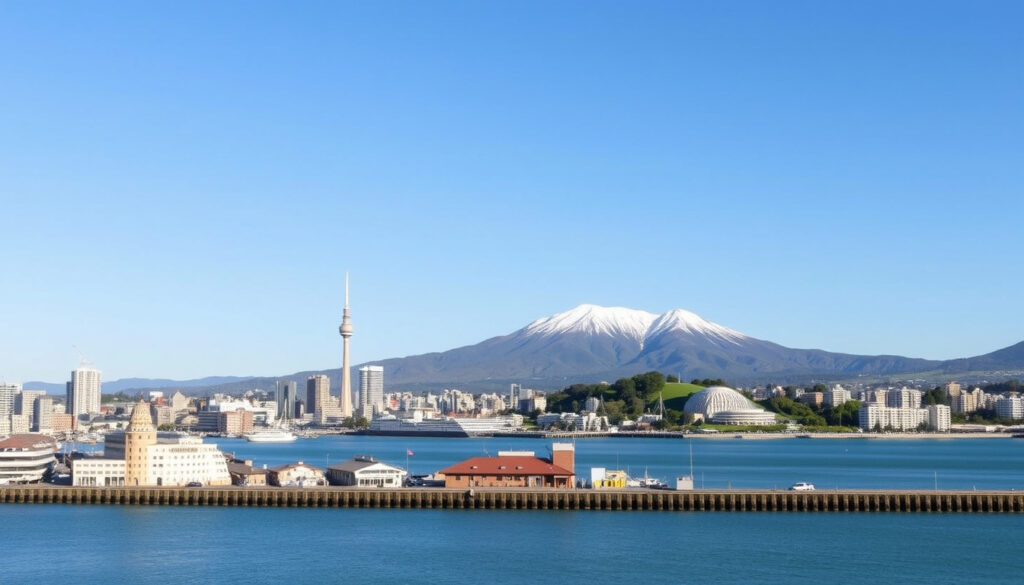
Capital of New Zealand: Why Wellington Holds the Title
Few people realise that New Zealand’s capital wasn’t always Wellington — or that the country has had three capitals in its short history. Understanding why Wellington holds the title today, and how Auckland lost it, reveals a story of gold rushes, political compromise, and a logistical feat that cost £54,665.
Capital city: Wellington ·
Population (city proper): 215,000 (approx.) ·
Metropolitan population: 440,000 (approx.) ·
Largest city: Auckland (1.7 million metro) ·
Year capital moved to Wellington: 1865 ·
Previous capital: Auckland (1841–1865)
Quick snapshot
- Wellington has been the capital since 1865 (Wikipedia)
- Auckland was capital from 1841 to 1865 (New Zealand Parliament)
- First capital was Okiato (Russell) in 1840–1841 (NZHistory)
- Wellington’s status remains by convention, not statute — no change expected (Wikipedia)
Six key facts about New Zealand’s capital, one pattern: the seat of government has moved southward over time, following population shifts and political needs.
| Label | Value |
|---|---|
| Official capital | Wellington |
| Time zone | NZST (UTC+12) |
| Language | English, Māori, NZ Sign Language |
| Currency | New Zealand dollar (NZD) |
| Government seat | Parliament Buildings (The Beehive) |
| Population rank in NZ | Second (after Auckland) |
Is Auckland or Wellington the capital?
Wellington is the official capital of New Zealand. Auckland is the largest city — with a metropolitan population of about 1.7 million — but it has not been the capital since 1865 (Wikipedia). Both cities are on the North Island, but their roles are distinct: Wellington is the political and administrative hub, while Auckland is the economic engine.
One comparison, two different city profiles:
| Feature | Wellington | Auckland |
|---|---|---|
| Status | Capital (since 1865) | Largest city (former capital 1841–1865) |
| Metro population | ~440,000 | ~1.7 million |
| Primary role | Government, culture, film | Commerce, tourism, diversity |
| Notable landmark | Beehive (Parliament) | Sky Tower |
Bottom line: Wellington is the capital; Auckland is the largest city. For travellers, the distinction matters: government business happens in Wellington, while Auckland handles the bulk of international trade and flights.
The implication: visitors expecting a capital city like Canberra or Ottawa will find Wellington compact and walkable, not sprawling. The trade-off is that the seat of government sits in a smaller, more intimate city with a strong creative pulse.
Why is Wellington the capital of New Zealand?
Geographical centrality and political compromise
By the 1860s, New Zealand’s population was shifting south due to gold rushes in Otago and Canterbury. The South Island’s population had overtaken the North Island’s (Waitangi Treaty Grounds). Auckland, at the northern tip of the North Island, felt increasingly remote. An independent commission appointed by the governors of the Australian colonies visited several sites — Wellington, Whanganui, Picton, Port Underwood, Havelock, and Nelson — and chose Wellington for its central location and good harbour (NZHistory).
The commission’s choice reflected a pragmatic need: a capital that could serve both islands equally, at a time when the South Island demanded a fair share of government attention.
Natural harbour and defence advantages
Wellington’s harbour, protected by hills, was considered safer and more accessible than Auckland’s Waitematā Harbour for the shipping of the era. The move also came after a decade of argument in Parliament about where the seat of government should be (Wikipedia).
The decision was formalised in 1863 when a proposal to locate the capital on the shores of Cook Strait was made (Te Ara). The actual move took two years to complete.
The pattern: New Zealand’s capital choice was less about declaring a single city’s superiority and more about balancing regional power — a compromise that still shapes the country’s political geography.
Why is Auckland no longer the capital of New Zealand?
Governors and parliament’s relocation
Auckland was established as the capital by Governor William Hobson in 1841 (Waitangi Treaty Grounds). But the New Zealand Parliament spent its first ten years in Auckland, and by the early 1860s, sentiment had shifted. The government had already held a parliamentary session in Wellington in 1862 on a temporary basis (Te Ara).
South Island settlement and the need for central government
The gold rushes in Otago (1861) and the West Coast (1864) drew thousands of settlers south. Southern provinces pushed for a capital closer to the centre of the growing colony. The commission’s 1863 visit to multiple sites confirmed that Wellington was the best compromise (NZHistory).
Official move in 1865
On 26 July 1865, the first session of Parliament was held in Wellington — a date widely treated as the point when Wellington became the de facto capital (Wellington City Council). The move itself was a substantial logistical exercise: public records and about 80 cases of library books were shipped to Wellington in late March 1865 (RNZ). The total cost came to £54,665 (NZHistory).
The catch: Auckland’s capital status simply ended when the seat of government moved — no law was passed to revoke it. New Zealand’s capital has always been a matter of convention, not statute.
What is the third biggest city in New Zealand?
New Zealand’s settlement hierarchy can be confusing because city proper and metropolitan boundaries differ. Here’s a look at the largest urban areas:
- 1. Auckland – metro population ~1.7 million
- 2. Wellington – metro population ~440,000
- 3. Christchurch – metro population ~400,000
- 4. Hamilton – metro population ~180,000
So Wellington is the second-largest city by metro population, not the third. Christchurch, the largest city in the South Island, ranks third (Wikipedia).
Why is Wellington so famous?
Creative capital and film industry
Wellington is often called New Zealand’s “creative capital.” It’s home to Weta Workshop, the special-effects company behind The Lord of the Rings and Avatar films. The city’s film industry draws international talent and tourists (100% Pure New Zealand).
Political and administrative hub
The Beehive, the executive wing of the New Zealand Parliament, is an iconic landmark. The government, Parliament, Supreme Court, and most public services are based in Wellington (Wikipedia).
Café culture, harbour, and natural beauty
Wellington consistently ranks among the world’s most livable cities. Its compact centre, waterfront, and hillside suburbs give it a Mediterranean feel. The city’s café culture is legendary: it has more cafés per capita than Melbourne (100% Pure New Zealand).
The pattern: Wellington’s fame rests on three pillars — creativity, government, and quality of life — making it a destination for both tourists and professionals.
Timeline
- 6 February 1840 – Treaty of Waitangi signed; Okiato (Russell) chosen as first capital (NZHistory).
- 1841 – Capital moved to Auckland (Waitangi Treaty Grounds).
- 1863–1865 – Government decides to move capital to Wellington due to central location (Te Ara).
- 26 July 1865 – First Parliament session held in Wellington; official capital (Wellington City Council).
- 1880s–present – Wellington developed as administrative and cultural centre.
Clarity: Confirmed vs. Unclear
Confirmed facts
- Wellington is the current capital of New Zealand.
- Auckland was the capital from 1841 to 1865.
- Okiato (Russell) was the first capital in 1840.
- The capital moved to Wellington because of its central location and harbour.
What’s unclear
- The exact reason for choosing Wellington over other southern locations like Nelson or Picton is not definitive; historical compromise is cited.
- Whether Russell or Okiato is considered the first capital depends on definitions (the settlement site vs. the town).
Quotes
“Wellington was selected for its central location and good harbour.”— Waitangi Treaty Grounds, New Zealand’s 3 National Capitals
“The capital move followed a decade of argument about where the seat of government should be located.”— Wikipedia, Capital of New Zealand
“Wellington’s status as capital is established by constitutional convention rather than by statute.”— Wikipedia, Wellington
Summary
New Zealand’s capital is Wellington — a city chosen by commission, moved into by logistical effort, and secured by convention. The 1865 shift from Auckland reflected population pressures, regional politics, and the need for a central harbour. For travellers and newcomers, the distinction between largest city and capital matters: Wellington offers the pulse of government and creativity, while Auckland drives commerce. The choice is clear: Wellington is where the decisions are made, even if the numbers are bigger elsewhere.
wellington.govt.nz, archivesonline.wcc.govt.nz, en.wikipedia.org, aucklandtourism.org, britaindaily.uk
The shift from Auckland to Wellington in 1865 is explored in detail in why Wellington is the capital.
Frequently asked questions
What was the first capital of New Zealand?
Okiato (also called Old Russell) in the Bay of Islands served as the first capital from 1840 to 1841 (NZHistory).
How many capitals has New Zealand had?
Three: Okiato (1840–1841), Auckland (1841–1865), and Wellington (since 1865).
Why did New Zealand move its capital from Auckland to Wellington?
Because of Wellington’s more central location, better harbour, and pressure from the South Island’s growing population during the gold rushes (Waitangi Treaty Grounds).
What is the population of Wellington compared to Auckland?
Wellington’s metro population is about 440,000; Auckland’s is about 1.7 million. Wellington is the second-largest urban area.
Is Wellington the smallest capital city in the world?
No, but it is one of the smallest national capitals by population. Cities like Ngerulmud (Palau) and Funafuti (Tuvalu) are smaller.
What is the capital of the South Island?
New Zealand’s South Island does not have a capital; its largest city is Christchurch. The national capital is Wellington, which is on the North Island.
When did Wellington officially become the capital?
26 July 1865, when the first Parliament session was held in Wellington (Wellington City Council).
What is the significance of the Beehive building in Wellington?
The Beehive houses the executive wing of the New Zealand Parliament and is one of the country’s most recognisable landmarks.
Related reading
- Flights Hamilton to Wellington – useful for planning a visit.
- Opening a Bank Account in New Zealand: A Guide for Foreigners – practical info for newcomers.
More related posts
 NZ Super Pension Rules 2025 Changes & Overseas Guide
 What Is a Resume – Definition, Examples and Guide
 UAE vs South Africa – Match Result, Scorecard, Highlights
 Home and Land Packages – Complete 2025 Buyer Guide
 JB Hi-Fi Botany – Hours, Location, Reviews and Services
 Can You Take Aerosols in Checked Baggage NZ? Rules & Limits
 War of the Worlds – Novel, Broadcast and Adaptations Guide
 Hong Kong vs Man United – Final Score, Goals and Analysis