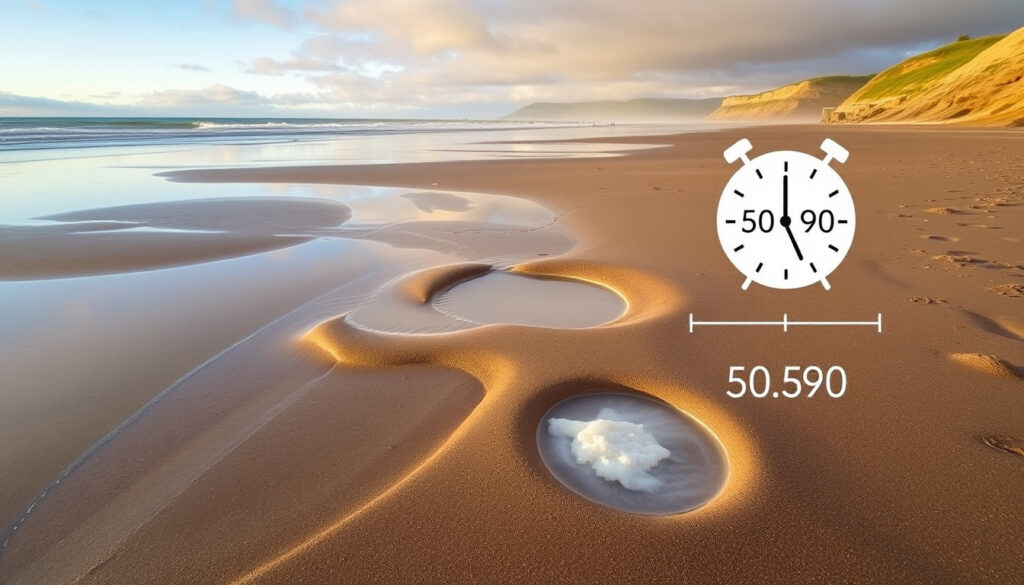
Hot Water Beach Tides: Best Time to Dig & 50/90 Rule Guide
There’s a stretch of sand on New Zealand’s Coromandel Peninsula where the ground itself gives you a warm welcome. Hot Water Beach lets you dig your own geothermal pool right at the tide line — but only if you show up at the right moment. Get the timing wrong, and the ocean swallows the hot springs whole. This guide lays out exactly when to go, how the 50/90 rule keeps you safe, and what locals actually do to find the hottest water.
Optimal low tide window: 2 hours each side of low tide ·
Typical low tide height: 0.2–0.8 m ·
Spring tide range: 1.5–2.0 m ·
Water temperature in pools: 60–64 °C ·
Time to dig a proper pool: 30–45 minutes ·
Recommended check-in before low tide: 1.5 hours
Quick snapshot
- Low tide ±2 hours (The Coromandel – regional tourism site)
- Check tide times at Metservice (The Coromandel – regional tourism site)
- Dig only between 50% and 90% of tidal range after low (REI Expert Advice – outdoor safety resource)
- Safer during spring tides (REI Expert Advice – outdoor safety resource)
- Bring a sturdy shovel (TripAdvisor – visitor advice)
- Dig a 1m wide basin (TripAdvisor – visitor advice)
- Adjust temperature with seawater (TripAdvisor – visitor advice)
- Never dig close to high tide mark (Manta Racks – tide safety guide)
- Watch for waves and currents (Manta Racks – tide safety guide)
- Keep children supervised (Manta Racks – tide safety guide)
| Fact | Value |
|---|---|
| Location | Coromandel Peninsula, New Zealand (The Coromandel) |
| Ideal tide condition | Low tide, 0.5 m or lower (Surfline – tide data platform) |
| Tidal pattern | Semidiurnal – two highs and two lows daily (Surf-Forecast – marine forecasts) |
| Recommended arrival before low tide | 3 hours to secure a good spot (TripAdvisor – visitor tips) |
| Safe digging window per 50/90 rule | 50% to 90% of tidal range after low tide (REI Expert Advice) |
| Typical low tide height | 0.8–1.7 ft (0.24–0.52 m) (Surfline) |
What tide is best for a Hot Water Beach?
Why low tide is the preferred time
- Low tide exposes the hot water springs that bubble up through the sand. According to The Coromandel (regional tourism authority), the best time to dig is two hours either side of low tide. When the sea retreats, the geothermal water seeps upward and you can channel it into a hand-dug basin.
- Data from Surfline (tide data provider) shows that low tides at Hot Water Beach range from 0.8 to 1.7 feet, leaving a wide strip of sand bare. The lower the tide, the more room you have to dig.
The implication: arriving even 30 minutes after low tide shrinks your usable beach dramatically. The outgoing tide reveals the springs gradually, but the incoming tide reclaims them fast.
Understanding the 50/90 rule for safe digging
- REI Expert Advice (outdoor safety resource) defines the 50/90 rule: 50% of the tidal range occurs in the first hour after low tide, and 90% within three hours. At Hot Water Beach, that means the water level rises half its full height in the first 60 minutes — plenty of time to dig and soak, but also a clear deadline.
- Manta Racks (tide safety guide) warns that rapid water level changes can flood access points. Staying below 90% of the range keeps you above the rising water.
A first-time visitor who ignores the 50/90 rule faces a soggy surprise: the ocean can rise fast enough to wash out a pool in under 20 minutes once the tide passes the 90% mark. For families with children, that urgency turns a relaxing soak into a rushed exit.
When can you dig at Hot Water Beach?
Ideal times relative to low tide
- The consensus among regulars, echoed on TripAdvisor (visitor advice forum), is to arrive three hours before low tide to claim a spot before the crowd arrives. The first hour after low tide is the sweetest: the hot water is concentrated and the beach is still expanding.
- Spring tides — which occur during full and new moons — produce lower lows and higher highs. According to Surf-Forecast (marine forecasting service), these tidal extremes can expose extra beach, giving diggers a larger canvas.
Spring tides also mean faster-moving water on the incoming. The same exposure that gives you room also makes the return of the sea more forceful. Digging further out on a spring tide requires trusting the 90% bound.
The pattern: the ideal digging window is roughly 1.5 to 2.5 hours after low tide — and never more than 3 hours after low, when the water covers the hot zone.
Seasonal considerations and weather effects
- Heavy rain can dilute the geothermal flow, making pools less hot. While no precise study exists, The Coromandel recommends checking the 3‑day forecast and avoiding torrential downpours.
- Summer (November–March) sees the highest visitor numbers. Peak crowds mean competition for the hottest water near the rock outcrop. A local operator at Flaxmill Accommodation advises arriving even earlier on summer weekends to beat the rush.
Why this matters for your trip: a winter visit offers solitude but colder air temperatures; summer delivers warmth but queues. Plan your season based on your tolerance for both cold air and company.
What is the 50 90 rule for tides?
How the 50/90 rule applies to Hot Water Beach
- The rule was popularised by kayakers to predict paddle‑out windows, but it translates directly to safe beach digging. REI Expert Advice explains that in the first hour after low tide, the water level rises by half the total tidal range; by three hours, it reaches 90% of that range.
- At Hot Water Beach, where the tidal range can hit 2.0 metres during spring tides, the first hour lifts the water by about 1.0 metre — enough to cover most pools if you are digging near the lower limit.
What this means for diggers: you have roughly two to three hours of productive pool time. Beyond that, the rising water overtakes the hot springs and your spot is gone.
Safety implications of the rule
- Manta Racks (tide safety guide) stresses that the 90% mark is a hard upper boundary. Digging above that point means building a pool in the wave swash zone — dangerous for small children and likely to collapse.
- Data scientist Austin Rochford, who helped formalise the rule for kayaking, noted that the 50% threshold marks the line where you can still safely exit a tidal area. At Hot Water Beach, staying below 50% feels generous, but the rule keeps you oriented to the clock.
Respecting the 90% line means you leave some unsogged beach, but it guarantees you won’t be cut off. For a family, that margin is cheap insurance. For an experienced digger, pushing to 95% might yield a hotter pool — but only if you’re prepared to pack up fast.
The takeaway: the 50/90 rule isn’t a guess; it’s a tide cheat code. Use it to time your entry and exit, and you’ll never get stuck.
Can you go to Hot Water Beach at high tide?
What happens during high tide at Hot Water Beach
- At high tide the entire hot spring zone is submerged. According to Surfline, water depths at high tide can reach 2 metres or more, making digging impossible — the sand where the geothermal vents sit is covered by seawater.
- Ocean Clock (tide guide) notes that high tide brings surf closer to the shore. At Hot Water Beach, that means waves lap right up to the vegetated dunes.
The catch: you can still walk the beach at high tide, but the geothermal heat is buried. No pool digging, no soak.
Is it still worth visiting?
- The beach itself is scenic year‑round. TripAdvisor reviews mention that even when the pools are inaccessible, the walk along the sand and the view of the Coromandel coastline are pleasant.
- But for the main attraction — the hot spring experience — high tide is a dead zone. Plan your entire visit around the tide chart.
The verdict: if you only have one chance to see the beach, go at low tide. If you arrive at high tide, you’re limited to a shoreline stroll and a promise to return later.
How to dig the best pool at Hot Water Beach
Step-by-step pool construction
- Check the tide chart for the day. Use Surf-Forecast or Metservice and note the low time and height.
- Arrive at least 1.5 hours before low tide (3 hours if you want a prime spot, per TripAdvisor).
- Head to the northern end of the beach where the rock outcrop sits. Hot water emerges strongest there — The Coromandel notes that the geothermal vent is concentrated in that area.
- Dig a shallow basin about 1 metre wide and 30 cm deep. A sturdy shovel (TripAdvisor advice) makes the job easier.
- Let the hot water flow in from the bottom. Adjust the temperature by scooping in cooler seawater from the edge.
- Sit and soak, but keep an eye on the incoming tide. Use the 50/90 rule to know when to pack up.
Tools and tips from locals
- Shovel type: a garden trowel works in a pinch, but a long‑handled spade saves your back. TripAdvisor contributors emphasise that lightweight plastic shovels break on the compacted sand.
- Rock outcrop trick: “Dig near the large rock outcrop on the northern end,” advises a local operator at Flaxmill Accommodation. “That’s where the hottest water comes up.”
- Temperature control: Manta Racks suggests digging a channel from the hot inflow to a cooler pool so you can mix to your liking.
The best pool isn’t the deepest — it’s the one with the right mix. A first‑timer who digs too deep gets scalding water; someone who skips the seawater tap ends up with a lukewarm puddle. Aim for a basin that lets you adjust by hand.
Upsides and downsides of digging at Hot Water Beach
Upsides
- Unique geothermal experience — dig your own hot pool on the ocean edge.
- Free to use; no entry fee required.
- Safe for families when timed correctly (low tide with supervision).
- Scenic location on the Coromandel Peninsula with other attractions nearby.
Downsides
- Tight window — only 2–3 hours around low tide.
- Crowded during peak season (Nov–Mar), especially on weekends.
- Requires equipment (shovel, towel, water shoes) and advance planning.
- No shelter or changing facilities at the beach itself.
Confirmed facts and what remains unclear
Confirmed facts
- Low tide is the only safe time to dig hot pools (The Coromandel).
- Hot water emerges from a geothermal vent beneath the beach (Surfline).
- The 50/90 rule is a widely used heuristic for tidal safety (REI Expert Advice).
What’s unclear
- Exact pool temperature varies — mixing with cold seawater makes it unpredictable.
- Optimal digging spots shift as sand moves with storms and currents.
- Weather effects on water temperature lack precise documentation.
Quotes from locals and experts
“Dig near the large rock outcrop on the northern end of the beach. That’s where the hottest water comes up.”
— Local operator at Flaxmill Accommodation
“The 50/90 rule came from kayakers who needed to predict safe paddle‑out windows. It works just as well for beach digging.”
— Austin Rochford, data scientist who formalised the rule
“Check Metservice tide times at least 24 hours before you go. The tides shift by about 50 minutes each day.”
— Seabreeze Holiday Park staff
For anyone planning a trip, the takeaway is clear: respect the tide, bring a shovel, and head for the rock outcrop. The hot water waits, but only for two hours either side of low tide.
Frequently asked questions
What time of day should I go to Hot Water Beach?
Go during low tide. The exact time varies daily; check a tide chart for Hot Water Beach on Metservice or Surf-Forecast.
Do I need to bring a shovel?
Yes. A sturdy shovel or spade is essential. Lightweight plastic shovels often break in the compacted sand.
Is there an entrance fee to use the hot springs?
No. The beach is public and free to access. Parking may be charged in the summer season.
Can I visit Hot Water Beach during high tide for swimming?
Yes, you can swim at high tide, but the hot springs will be submerged. No digging possible.
How long does the hot water last after low tide?
Roughly 2–3 hours. As the tide rises above 90% of its range, the pools are overrun.
Are there changing rooms or toilets at the beach?
There are basic toilet facilities, but no changing rooms. Bring a towel and change discreetly or use nearby accommodations.
Is Hot Water Beach safe for toddlers?
Yes, with supervision. Keep young children away from the hottest water inflow and watch for incoming waves. Dig only during low tide within the 50/90 safe zone.
What other attractions are near Hot Water Beach?
Nearby points of interest include Cathedral Cove, Hahei Beach, and the Coromandel Coastal Walkway. For a different perspective, consider a Milford Sound scenic flight or hike One Tree Hill in Auckland.
More related posts
 07 Area Code NZ: Regions Covered (Waikato, Bay of Plenty)
 Chicken Parmigiana Near Me: Best Local Spots & Ordering Guide
 New Zealand Stock Exchange – Complete 2025 Guide
 Mitsubishi Electric Heat Pump Guide: Efficiency, Cost & Lifespan
 Long Puffer Jacket NZ: Best Women’s Options & Reviews
 Mediterranean Diet Meal Plan: 7-Day Beginner Guide
 Icon of the Seas Cruise Ship: Cost, Capacity, 2026 Sailings
 George of the Jungle: Cast, Plot, Parody & Kids Guide