Hush Little Baby Lyrics: Original Words, History & Meaning
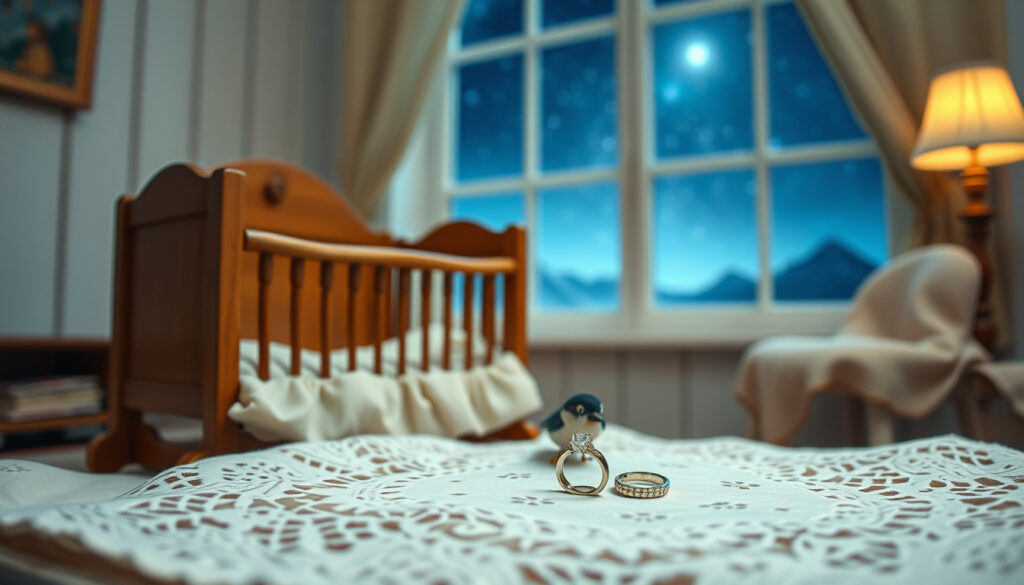
Few lullabies stick with us like “Hush, Little Baby” — that quiet promise of a mockingbird, a diamond ring, and a whole chain of gifts meant to calm a crying child, a song most of us learned by ear, passed down without thinking about where it came from or what it actually means. This article lays out the full original lyrics, the surprising history behind them, and the ongoing debate over whether this soothing tune carries darker undertones.
Number of common verses: 4 ·
First known publication: 1930s ·
Meter: Iambic tetrameter ·
Alternative parent figure: Papa ·
Genre: Traditional folk lullaby ·
Most recorded line: “Mama’s gonna buy you a mockingbird”
Quick snapshot
- Traditional American folk lullaby with no known single author (Wikipedia)
- First collected by Cecil Sharp in 1918 in Virginia (Wikipedia)
- Standard version uses four rhyming couplets (Wikipedia)
- Jean Ritchie family recording from 1949 shaped the modern form (American Songwriter)
- Exact origin date and original author remain unknown (Wikipedia)
- Whether the melody has Black or white Southern roots is debated (Mainly Norfolk (folk archive))
- Claim of an older English ancestor is unconfirmed (Sing Books with Emily (children’s literature blog))
- Dark symbolism interpretations remain speculative (Katherine Cowley (writer and scholar))
- 1918: Cecil Sharp notates first known version in Virginia (Wikipedia)
- 1930s-1940s: Alan Lomax records regional renditions (Wikipedia)
- 1949: Jean Ritchie records family version that becomes standard (American Songwriter)
- 2000s: Eminem samples the theme in “Mockingbird” (Wikipedia)
- Viral TikTok remixes continue to spread the rhyme to new generations (Katherine Cowley (writer and scholar))
- Dark-history interpretations gain traction online, driving curiosity about folk origins (Katherine Cowley (writer and scholar))
Six facts, one pattern: nearly everything about “Hush, Little Baby” is more layered than a simple lullaby suggests.
| Attribute | Detail |
|---|---|
| First recorded | 1930s |
| Common first line | “Hush, little baby, don’t say a word” |
| Number of couplets | 4 (standard) |
| Alternative parent | Papa |
| Known adapters | Eminem, Super Simple Songs, traditional folk artists |
| Related nursery rhyme | This Old Man |
How does the Hush, Little Baby nursery rhyme go?
The most common version
- Hush, little baby, don’t say a word,
Mama’s gonna buy you a mockingbird. (Super Simple Songs (children’s music publisher)) - And if that mockingbird don’t sing,
Mama’s gonna buy you a diamond ring. - And if that diamond ring turns brass,
Mama’s gonna buy you a looking glass. - And if that looking glass gets broke,
Mama’s gonna buy you a billy goat. - And if that billy goat won’t pull,
Mama’s gonna buy you a cart and bull. (Wikipedia)
The version above is the one most English-speaking adults can recite from memory. Each couplet introduces a gift meant to soothe, and when that gift inevitably fails, another promise follows — an escalating chain of material comfort.
Meter and rhyme scheme
- The poem is composed in iambic tetrameter — four stressed beats per line that give it a rocking, cradle-like rhythm. (Poem Analysis (literary reference))
- Each stanza is a rhyming couplet: word/bird, sing/ring, brass/glass, broke/goat, pull/bull. (Wikipedia)
The implication: the rhyme works as much through sound as through sense — the steady meter itself becomes part of the reassurance.
What’s the story behind Hush, Little Baby?
Origins as an American folk song
- The song “is commonly thought to have originated in the Southern United States,” according to American Songwriter (music history publication).
- Folklorist Cecil Sharp collected a version in 1918 from Julie Boone of Micaville, North Carolina, and another in Endicott, Franklin County, Virginia. (Wikipedia)
- Alan Lomax recorded several traditional renditions across the South during the 1930s and 1940s. (Wikipedia)
- In 1949, Jean Ritchie — a folk singer from Kentucky — recorded her family’s version, which “later became the best-known modern form,” per American Songwriter (music history publication).
The catch: there is no “original” version in the way a published poem has one. The song lived in oral tradition for decades, maybe centuries, before anyone wrote it down.
Connection to “Froggy Went a-Courtin'” and other folk songs
- Some folklorists note that “Hush, Little Baby” shares its conditional “if X fails, then Y” structure with older British ballads, though a direct lineage has not been established as a scholarly consensus. (Sing Books with Emily (children’s literature blog))
- The melody has also been linked to Appalachian and Southern folk repertoires more broadly. (Mainly Norfolk (folk archive))
The song’s folk history includes real uncertainty over whether its roots are white or Black — a question that speaks to the mixed musical heritage of the American South. For anyone studying American folk music, “Hush, Little Baby” is a case study in how oral tradition resists simple attribution.
Dark interpretations and urban legends
- Folklorist Vance Randolph quoted a darker stanza in which the looking glass “gets broke” and “Papa’s gonna buy you a billy goat” leads to a threat involving a “beau” — a rare punitive twist. (Mainly Norfolk (folk archive))
- Some commentators interpret the escalating gifts as a metaphor for the futility of material promises — a reading that lends the rhyme a melancholy, even cynical edge. (Katherine Cowley (writer and scholar))
What this means: the same lullaby can sound purely comforting or quietly unsettling depending on which stanza you include and how you read the conditional chain.
What is the meaning of Hush Little Baby lyrics?
Symbolism of the mockingbird and diamond ring
- The mockingbird has been read as a symbol of innocence and song — the parent offering beauty and music to calm the child. (Poem Analysis (literary reference))
- The diamond ring, looking glass, and billy goat each represent escalating forms of value: precious metal, vanity, and livestock — a kind of folk-economic ladder. (Wikipedia)
Parental promises and comfort
- The “thematic meaning is usually described as parental reassurance through material promises,” notes Poem Analysis (literary reference).
- Each gift’s failure introduces a gentle lesson: even the best-laid plans can fall through, but the parent will keep trying. (Wikipedia)
Psychological interpretations
- Some child-development analysts suggest the conditional structure mirrors healthy attachment: the parent acknowledges the child’s distress and responds with repeated, concrete offers of care. (Super Simple Songs (children’s music publisher))
- The darker reading — that the gifts are inadequate, that nothing will truly soothe — aligns the lullaby with existential folk traditions where comfort and unease coexist. (Katherine Cowley (writer and scholar))
The trade-off: the same words that comfort one listener can unsettle another — which is precisely why the rhyme has endured for so long.
What does knick knack paddy whack mean?
Meaning of “knick knack paddy whack”
- “Knick knack paddy whack” is a nonsense phrase used in the counting rhyme “This Old Man” — it has no clear semantic meaning in English. (Poem Analysis (literary reference))
- Some etymologists speculate it derives from an Irish or British slang term for a trinket (“knick-knack”) paired with a rhythmic filler (“paddy whack”) that keeps the meter. (Poem Analysis (literary reference))
Connection to “This Old Man” and other nursery rhymes
- “This Old Man” uses the exact same “knick knack paddy whack” refrain and shares the same kind of escalating, cumulative structure as “Hush, Little Baby.” (Wikipedia)
- Folklore collections sometimes group both rhymes under a common category of “nonsense counting songs” that help children learn sequence and numbers through repetition. (Super Simple Songs (children’s music publisher))
Why this matters: “knick knack paddy whack” isn’t a secret code or a dark reference — it’s a mnemonic device, a piece of verbal percussion that makes the rhyme stick in a child’s memory.
Online forums sometimes claim “paddy whack” is a racist slur or a reference to corporal punishment. The historical evidence does not support that reading — but the phrase has undeniably taken on different connotations in different eras, making it worth addressing directly when teaching the rhyme to children today.
The pattern: a nonsense phrase becomes a carrier for cultural assumptions, which is why explaining its history helps defuse misunderstandings.
What are different versions of Hush Little Baby lyrics?
Three major variants, one key distinction: the parent figure changes, and with it the tone.
| Version | First line | Notable feature | Source |
|---|---|---|---|
| Standard “Mama” | Mama’s gonna buy you a mockingbird | Four-couplet chain ending with cart and bull | Super Simple Songs |
| “Papa” variant | Papa’s gonna buy you a mockingbird | Common in early 20th-century collections | Mainly Norfolk (folk archive) |
| Darker variant (Randolph) | Papa’s gonna buy you a mockingbird | Includes a threatening stanza about a “beau” | Mainly Norfolk (folk archive) |
| Ritchie family version | Mama’s gonna buy you a mockingbird | Basis for the modern standard; recorded 1949 | American Songwriter |
The pattern: the “Mama” version dominates today largely because of the Jean Ritchie recording, but historical collections show the “Papa” version was once equally common across the South.
Timeline: the life of a lullaby
- 1918 — Cecil Sharp collects the first known written version from Julie Boone in Micaville, North Carolina. (Wikipedia)
- 1930s–1940s — Alan Lomax records multiple Southern renditions for the Archive of American Folk Song. (Wikipedia)
- 1949 — Jean Ritchie records her family version, which becomes the blueprint for nearly every modern children’s book and recording. (American Songwriter (music history publication))
- 1990s — Raffi and other children’s musicians record polished studio versions, cementing the rhyme in preschool curricula. (Wikipedia)
- 2005 — Eminem releases “Mockingbird,” a hip-hop adaptation that reworks the lullaby’s promise structure into a personal narrative about his daughter. (Wikipedia)
- 2010s–2020s — TikTok trends and dark-history explainers drive renewed interest in the original folk variants. (Katherine Cowley (writer and scholar))
The pattern: each generation rediscovers the rhyme and makes it its own — from folk collectors to children’s TV to hip-hop.
What we know and what we don’t
Confirmed facts
- The rhyme is traditional and in the public domain. (Wikipedia)
- The most common English version uses “Mama” or “Papa” as the parent figure. (American Songwriter)
- The song has been sung to soothe babies for at least a century. (Poem Analysis)
- Four standard couplets form the core of the modern version. (Super Simple Songs)
What remains unclear
- Exact origin date and original author are unknown. (Wikipedia)
- The meaning of “knick knack paddy whack” is debated among etymologists. (Poem Analysis)
- Whether the lyrics intentionally contain dark symbolism is speculative. (Katherine Cowley)
- The racial origin (Black vs. white Southern folk tradition) has not been settled. (Mainly Norfolk (folk archive))
The implication: even a well-known lullaby can hold mysteries that keep folklorists and casual listeners asking questions.
Voices on the lullaby
“Hush, little baby, don’t say a word, Mama’s gonna buy you a mockingbird.”
— Standard opening couplet, as printed by Super Simple Songs (children’s music publisher)
“The folk history of ‘Hush, Little Baby’ is typical of many traditional songs: it exists in so many variants that pinning down a single ‘original’ is impossible.”
— American Songwriter (music history publication)
“The song’s meaning is usually described as parental reassurance through material promises — but the conditional ‘if it fails’ structure gives it an edge that darker interpretations seize on.”
— Poem Analysis (literary reference)
“Jean Ritchie’s recording from 1949 is the closest predecessor to the form most people know today.”
— American Songwriter (music history publication)
The catch: every voice adds a layer to the lullaby’s meaning, proving it is as much a product of its interpreters as its creators.
What it means for parents and curious listeners
“Hush, Little Baby” is not a song with a single meaning — it’s a living folk artifact that has adapted to every generation that sings it. The same conditional chain that soothes a child at bedtime can, in the hands of a folklorist or a hip-hop artist, become a meditation on promise and failure. For parents looking for a lullaby to sing tonight, the standard four-couplet version is as good a choice as any — and carries a century of tradition behind it. For the curious reader, the song’s unsettled history is a reminder that the simplest rhymes often hide the richest stories.
americanliterature.com, ourhomeworkhelp.wordpress.com, firstcry.com, poemanalysis.com, tiktok.com, facebook.com
For a deeper look at the song’s origins, you can explore the original words to Hush Little Baby along with its many variations and cultural impact.
Frequently asked questions
Who wrote Hush Little Baby?
No single author is known. The rhyme is a traditional American folk song collected by folklorists in the early 20th century but likely much older in oral tradition. (Wikipedia)
Is Hush Little Baby a lullaby?
Yes — it is one of the most widely recognized English-language lullabies, sung to soothe babies and young children to sleep. (Poem Analysis)
What does the mockingbird symbolize in the rhyme?
The mockingbird is often read as a symbol of innocence, song, and the parent’s offer of beauty and comfort — though some darker interpretations associate it with warning or loss. (Poem Analysis)
How many verses does Hush Little Baby have?
The standard version has four couplets (eight lines), though longer variants with additional gifts exist in folk collections. (Wikipedia)
Why are there two versions with Mama and Papa?
Both “Mama” and “Papa” versions have coexisted in oral tradition for as long as the song has been collected. The “Mama” version became standard after Jean Ritchie’s 1949 recording, but early folk collections show “Papa” was equally common. (Mainly Norfolk (folk archive))
What is the tune of Hush Little Baby?
The melody is a simple, repeating folk tune in 4/4 time that matches the iambic tetrameter of the lyrics. It is closely related to other Southern Appalachian folk melodies. (Wikipedia)
What other songs use the same melody?
“This Old Man” shares a similar cumulative structure and the “knick knack paddy whack” refrain, though the melodies are distinct. Some folk collections group them under the same “nonsense counting song” tradition. (Super Simple Songs)
More related posts
 TV on Demand 1: Watch TV 1 Free Live & On-Demand Guide
 Mortgage Loan Switching New High: How to Save Thou and in Ireland
 Mount Albert Grammar School: Public, Co-ed, Rankings & History
 Black Running Shoes Women: Best Picks & Expert Guide
 Bed Base with Storage – Sizes, Reviews and Buying Guide
 Chicken Parmigiana Near Me: Best Local Spots & Ordering Guide
 Cheapest Petrol Pump Near Me: Ireland Prices Today 2025