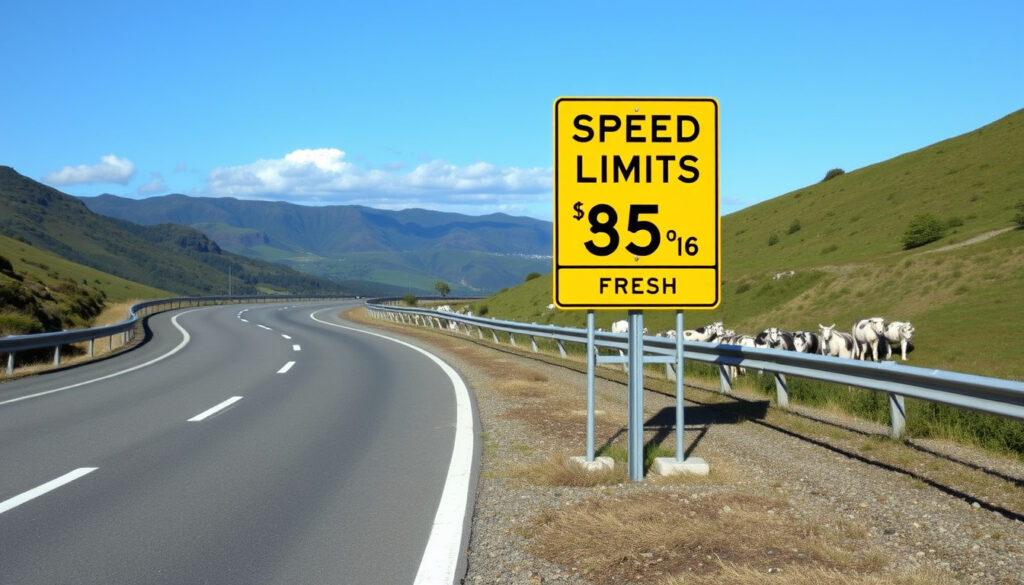
NZ Road Rule Changes 2025: Speed Limits, Road Code Updates & More
Speed limit signs on New Zealand state highways are changing this year as part of a government mandate to reverse certain lower limits introduced after January 2020, with the Land Transport Rule: Setting of Speed Limits 2024 requiring those reversals by 1 July 2025. Alongside highway speed resets, new variable speed limits near schools are being phased in by mid-2026.
Speed reversal deadline: 1 July 2025 ·
First tranche of highway sections: 38 ·
Sections under consultation: 49 ·
School zone variable speed limit deadline: 1 July 2026
Quick snapshot
- Speed limits on interregional connector state highways lowered since 1 Jan 2020 must automatically reverse by 1 July 2025 (Beehive.govt.nz (New Zealand Government press release))
- School zones must have 30 km/h variable speed limits on local streets and 60 km/h or less on rural roads by 1 July 2026 (Auckland Transport (local transport authority))
- Permanent 30 km/h limits on local streets introduced on or after 1 Jan 2020 where a school was the reason must be reversed (Auckland Transport (local transport authority))
- Exact list of all state highway segments affected beyond the first 38 confirmed and 49 under consultation
- Whether any changes to urban speed limits beyond school zones will follow
- Whether any new distracted driving laws will be introduced in 2025
- 29 January 2025: First reversals begin on 38 state highway sections (Beehive.govt.nz)
- 30 January – mid-March 2025: Public consultation on 49 additional sections (Beehive.govt.nz)
- 30 March 2025: Auckland Stage 1 urban connector reversals completed (Auckland Transport)
- 1 May 2025: Councils advise NZTA on local road reversals (Queenstown Lakes District Council presentation)
- 1 July 2025: All mandated reversals complete (Beehive.govt.nz)
- 1 July 2026: School zone variable speed limits mandatory on all local streets and rural roads outside schools (Beehive.govt.nz)
- Final reversal decisions on the 49 consulted sections expected after March 2025
- Local councils must complete their reversals by July 2025, with school zone changes deferred to 2026
- Urban speed limit rules beyond the current reversals remain under review
Six key facts summarise the main 2025 road rule changes at a glance.
| Fact | Value |
|---|---|
| Speed reversal deadline | 1 July 2025 |
| Road Code update release | 1 April 2026 |
| Heavy vehicle change | Removal of 50MAX permitting and H Plate |
| Trafinz submission | March 2026 |
| Affected highways | Interregional connector sections of state highways |
| Legal alcohol limit (20+) | 0.05% BAC or 250 mcg breath |
What speed limit changes are planned for 2025 in New Zealand?
The most immediate change drivers will see is the reversal of speed limits on many state highways. Under the Land Transport Rule: Setting of Speed Limits 2024, which took effect on 30 October 2024, any lower speed limit introduced on an interregional connector section of state highway on or after 1 January 2020 must automatically revert to its previous higher limit by 1 July 2025 (Auckland Transport).
Reversals on interregional connector state highways
- The first tranche covers 38 sections of the state highway network where reversals began on 29 January 2025 (Beehive.govt.nz).
- A further 49 sections were placed out for public consultation from 30 January 2025, lasting six weeks, before final reversal decisions (Auckland Transport).
- Only interregional connector sections of state highways are affected – local roads and urban connectors are handled separately by councils.
For real-time updates on state highway closures, see our article on State Highway 1 closures.
The pattern: the government is prioritizing speed on interregional highways while deferring school zone changes to allow for variable signage installation.
School zone variable speed limits
By 1 July 2026, every school in New Zealand will have a variable speed limit on the road outside it. On local streets, that means a maximum of 30 km/h when children are present. On rural roads outside schools, the limit must be 60 km/h or less (Auckland Transport).
The catch: permanent 30 km/h limits that were introduced on local streets since 1 January 2020 specifically because of a school must be reversed back to their previous higher limit, and will be replaced with variable limits instead. Auckland Transport says these reversals will happen during May and June 2025 (Auckland Transport).
The implication: school zones will get smarter, not just slower. Permanent low speeds are being replaced by variable limits that apply only when children are actually there.
Local road reversals
Councils across the country are required to identify and reverse lower speed limits on their own roads. Under the 2024 rule, each territorial authority must reverse amended speed limits on specified roads to the previous limit by 1 July 2025 if the previous limit was higher (Queenstown Lakes District Council presentation). Councils had until 1 May 2025 to notify NZTA of the roads they intend to reverse.
Auckland Transport has already completed Stage 1 reversals on some urban connector roads by 30 March 2025. Local street reversals near schools are scheduled for May and June 2025 (Auckland Transport).
Drivers get higher speeds back on major highways and urban connectors, but near schools the safety benefit of permanent 30 km/h zones is being replaced by variable limits that still slow traffic during peak school times.
Timeline: Key dates for 2025 road rule changes
The following table outlines the timeline for the 2025 road rule changes.
| Date | Event |
|---|---|
| 30 October 2024 | Land Transport Rule: Setting of Speed Limits 2024 takes effect (Auckland Transport) |
| 29 January 2025 | Reversals begin on 38 state highway sections (Beehive.govt.nz) |
| 30 Jan – mid-Mar 2025 | Public consultation on 49 additional state highway sections (Auckland Transport) |
| 30 March 2025 | Auckland Stage 1 urban connector reversals completed (Auckland Transport) |
| 1 May 2025 | Councils notify NZTA of local road reversals (Queenstown Lakes District Council) |
| May–June 2025 | Local street reversals near schools in Auckland (Auckland Transport) |
| 1 July 2025 | All mandated speed limit reversals in place |
| 1 July 2026 | School zone variable speed limits mandatory nationwide (Auckland Transport) |
The pattern: the 2024 rule created a hard deadline of 1 July 2025 for most reversals, with school zone changes given an extra year to allow for the installation of variable signage. The two-stage approach gives councils time to consult and implement, but the core mandate is non-negotiable.
Clarity: What’s confirmed and what’s still unclear
Confirmed facts
- Speed limit reversals on interregional connector state highways by 1 July 2025 (Beehive.govt.nz)
- Variable speed limits of 30 km/h on local streets outside schools by 1 July 2026 (Auckland Transport)
- Variable speed limits of 60 km/h or less on rural roads outside schools by 1 July 2026 (Auckland Transport)
- Reversal of permanent 30 km/h limits on local streets where a school was the reason for the change (Auckland Transport)
- First tranche of 38 state highway sections already under reversal (Beehive.govt.nz)
What’s unclear
- Exact breakdown of all state highway segments that will undergo reversal (49 still under consultation)
- Whether urban speed limits beyond school zones will change further
- Whether any new distracted driving laws or alcohol limit changes are being considered
For the average New Zealand driver, the confirmed speed reversals mean that many highways and connectors will return to the speeds you likely drove before 2020. The school zone changes are a trade-off: lower permanent limits are being replaced by variable ones that only slow traffic when needed. The unclear items are important for anyone concerned about urban safety or distracted driving rules.
What this means: drivers should expect higher speeds on highways but variable limits near schools, with further clarity on urban speed limits and distracted driving laws still pending.
What officials are saying
“Speed limits on interregional connector sections of state highways that were lowered since 1 January 2020 also automatically reversed by 1 July 2025.”
Simeon Brown, Minister of Transport, via Beehive.govt.nz (New Zealand Government press release)
“The rule requires reversing permanent 30 km/h limits on local streets introduced on or after 1 January 2020 when a school was a reason for the change.”
Auckland Transport, via Auckland Transport (local transport authority)
Both statements confirm that the 2025 changes are not optional: the rule sets a clear legal obligation for NZTA and councils to implement the reversals by the deadlines.
Is it illegal to eat while driving in NZ?
No specific law prohibits eating while driving, but distracted driving can lead to fines under Section 7 of the Land Transport Act 1998. Using a handheld mobile phone while driving is illegal and carries a fine of NZ$80 and 20 demerit points.
Is it illegal to drive too slow in NZ?
There is no general minimum speed limit in New Zealand, but driving below 30 km/h on a 100 km/h road can be considered dangerous. The 2025 speed limit reversals apply to interregional connector sections, not minimum speeds.
What is the 4 second rule in NZ?
The 4 second rule is recommended for following distance in poor conditions, doubling the standard 2 second rule. It is not a legal requirement but is advised for safety in wet or icy conditions.
What are the main road rules in New Zealand?
The official New Zealand Road Code was updated on 1 April 2026 and includes new rules on speed management and heavy vehicle operations. Key 2025 changes include automatic reversal of speed limits on interregional connector sections and removal of 50MAX permitting. For more on vehicle regulations, see our guide on Vehicle Insurance in New Zealand.
Can I drive after 2 glasses of wine?
The legal alcohol limit for drivers aged 20 and over is 0.05% blood alcohol concentration (BAC) or 250 micrograms of alcohol per litre of breath. No changes to drink driving limits have been announced for 2025.
Can you wear headphones while driving in NZ?
Wearing headphones that cover both ears while driving is illegal under the Land Transport (Road User) Rule 2004. Single-ear headphones or earpieces used for mobile phone calls are allowed if they do not impair hearing.
youtube.com, facebook.com, facebook.com, static1.squarespace.com
Frequently asked questions
When do the 2025 New Zealand road rule changes take effect?
Most speed limit reversals on state highways take effect no later than 1 July 2025. The first reversals began on 29 January 2025. School zone variable speed limits must be in place by 1 July 2026.
Which speed limits are being reversed in 2025?
Speed limits that were lowered on interregional connector sections of state highways on or after 1 January 2020 are being reversed to their previous higher limits. This includes 38 sections already confirmed and 49 more under consultation. Local roads are also affected where councils have identified reversible limits.
Will there be changes to drink driving limits in 2025?
No changes to the legal blood alcohol limit (0.05% for drivers aged 20 and over) have been announced for 2025. The 2024 speed limit rule does not affect alcohol limits.
Do I need to retake my driving test after the changes?
No. The speed limit reversals and school zone variable limits do not require drivers to retake tests. However, it is your responsibility to observe current speed limits on any road you drive.
Is the New Zealand Road Code being updated in 2025?
The official Road Code was updated on 1 April 2026 to reflect the new speed management rules and heavy vehicle regulations. This update is already available online and in print.
What is the Land Transport Rules Reform Programme?
It is a multi-phase government programme aimed at modernising land transport rules. Phase 2, commencing in 2025, includes changes to heavy vehicle productivity rules. Speed limit reversals are part of separate rule changes under the 2024 Setting of Speed Limits rule.
How will the 2025 road rule changes affect heavy vehicle drivers?
Under Phase 2 of the Land Transport Rules Reform, heavy vehicle operators will see the removal of 50MAX permitting and H Plate signage. This simplifies the permitting system but does not change general speed limits.
For New Zealand drivers, the core message of the 2025 road rule changes is that many speed limits will revert to their pre-2020 levels, and schools will get smarter variable limits instead of permanently low zones. The trade-off is clear: higher speeds on highways and connectors, balanced by targeted safety near schools. Any driver who sticks with the 2-second rule and watches for changed signage will adapt easily.
More related posts
 Op Shops Open Today: Charity Shop Guide for Ireland
 House Movers North Shore: Costs, Red Flags & Moving Day Guide
 Wine Shop Near Me: Laws, Delivery & Top Shops in Ireland
 Perth Glory vs AC Milan: 0-9 Friendly Result and Report
 We Can Be Heroes: Review, Sequel, Age Rating & Guide
 Bryce Dallas Howard Movies: Filmography and Career
 Veon 32 Inch TV: Is It a Smart TV? Specs & Buyer Guide
 Home and Land Packages – Complete 2025 Buyer Guide