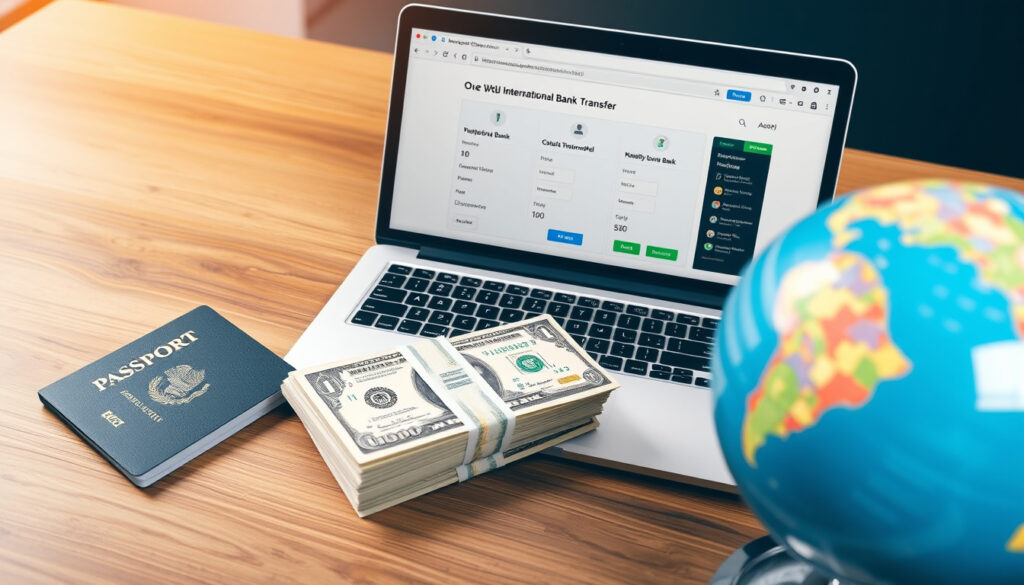
How to Send Money Overseas: Best Ways, Costs & $10k Rules
Anyone who’s ever needed to send money to family abroad or pay for a service overseas already knows the feeling: staring at a fee schedule and wondering what the real cost is. The advertised “$5 flat fee” often hides a poor exchange rate that eats another 3% or more. This guide cuts through the fine print, comparing the actual total cost of sending $500, $5,000, and $15,000 via bank wires, digital specialists like Wise and Revolut, and cash pickup services such as Western Union — including what happens when you hit the $10,000 reporting threshold.
Global money transfer market value (2025): over $200 trillion annually ·
Average fee for sending $500 abroad via bank: 4–6% including exchange rate markup ·
Typical bank wire transfer time: 1–5 business days ·
Wise average fee for $500 transfer: 0.5–1% (mid-market rate) ·
Western Union instant cash pickup availability: over 200 countries ·
Revolut monthly transfer limit on free plan: €1,000 at mid-market rate, then 0.5% fee
Quick snapshot
- Wise uses mid-market exchange rate with transparent fees (Wise (international transfer provider))
- Banks report wires over $10,000 to FinCEN in the US (MoneySavingExpert (UK consumer finance authority))
- Revolut offers €1,000 free monthly transfer at mid-market rate (Revolut (digital banking platform))
- Exact fee breakdown for every possible country pair — varies widely (MoneySavingExpert (consumer advice))
- Whether structuring laws apply to digital wallets the same as bank accounts (MoneySavingExpert (regulatory analysis))
- Future fee structure changes for AIB or Bank of Ireland international transfers (no official announcement) (MoneySavingExpert (consumer advice))
- Bank wire transfers: 1–5 business days (Bank of Ireland (Irish bank))
- Digital specialist (Wise/Revolut): minutes to 2 business days (Wise (transfer provider))
- Cash pickup (Western Union): instant in most locations (MoneySavingExpert (comparison site))
- More banks likely to adopt real-time cross-border payments (SEPA Instant expansion) (MoneySavingExpert (industry trends))
- Digital wallets (PayPal, Skrill) may introduce fee-free corridors (MoneySavingExpert (industry trends))
- Regulators could lower the $10,000 reporting threshold for digital transfers (MoneySavingExpert (industry trends))
A sender who wires $500 through a typical bank pays $25–$40 in fees and markup — while the same amount via Wise costs $3–$5. That gap widens dramatically at $15,000, where a bank can cost over $900 more than a digital specialist.
| Metric | Value |
|---|---|
| Average fee to send $500 via bank | $25–$40 (5–8% of amount) |
| Average fee to send $500 via Wise | $3–$5 (0.5–1%) |
| Western Union fee for $500 cash pickup | $10–$20 (2–4%, plus rate markup) |
| Reporting threshold in US | $10,000 (FinCEN Currency Transaction Report) |
| Time for bank wire transfer | 1–5 business days |
| Time for digital specialist (Wise/Revolut) | Minutes to 2 business days |
What is the best way to send money internationally?
How do banks compare to digital services for international transfers?
Six methods, one pattern: the more traditional the channel, the higher the total cost. Banks charge a flat wire fee (often $25–$50) plus a 3–5% markup on the exchange rate. Digital-first providers like Wise (international transfer specialist) and Revolut (digital banking app) use the mid-market rate and charge a small percentage fee. Cash pickup operators such as Western Union and MoneyGram (regulated cash-transfer services) charge moderate fees but apply a weaker exchange rate.
The table below shows the estimated total cost (fee + exchange rate loss) for three typical amounts, based on publicly available fee schedules and mid-market rates as of early 2026.
| Provider | $500 transfer | $5,000 transfer | $15,000 transfer |
|---|---|---|---|
| Typical US bank wire | $30–$48 (6–9.6%) | $175–$300 (3.5–6%) | $525–$900 (3.5–6%) |
| Wise | $3.75–$5 (0.75–1%) | $25–$50 (0.5–1%) | $75–$150 (0.5–1%) |
| Revolut (free tier first €1,000) | ≈ $2.50 (0.5%) after allowance | $25 (0.5%) above free limit | $75 (0.5%) |
| Western Union cash pickup | $15–$25 (3–5%) | $100–$200 (2–4%) | $300–$600 (2–4%) |
The trade-off: Digital specialists win on cost for any amount above $500, but bank wires remain the only option for recipients who require direct account deposits in currencies not supported by Wise or Revolut. Cash pickup is fastest but most expensive across the board.
What factors decide the best method for your transfer?
Four variables matter most: the amount you’re sending, the destination country, the recipient’s access to a bank account, and how urgently the money needs to arrive. For amounts under $1,000, Wise or Revolut are almost always cheapest. For $15,000+, the savings from using a digital specialist can exceed $400 compared to a traditional bank. If the recipient cannot receive digital transfers, Western Union or MoneyGram (cash pickup network) are the fallback.
The “cheapest” option can flip if you fund your transfer with a credit card instead of a bank account. Digital specialists often add a 1–3% surcharge for card payments, erasing their cost advantage.
How do I send money to someone’s account overseas?
Steps to send via online banking (e.g., Bank of Ireland, AIB)
- Log into your online banking platform (e.g., Bank of Ireland 365 online).
- Select the international payment or wire transfer option. You’ll need the recipient’s full name, bank name, account number (IBAN), and SWIFT/BIC code.
- Enter the amount and confirm the exchange rate offered. Be aware that the bank’s rate typically includes a 3–5% markup.
- Authorize the transfer. For amounts under €20,000 (or equivalent), Bank of Ireland processes online; larger sums require a paper form and branch visit.
- Wait 1–5 business days for the funds to arrive.
Steps to send via a digital app (Wise, Revolut, Western Union)
- Download the app (Wise, Revolut, or Western Union) and create an account. You’ll need to verify your identity with a photo ID.
- Select the destination currency and enter the amount. The app will show the total cost (fee + exchange rate) upfront.
- Choose how to fund the transfer: bank account (cheapest), debit/credit card, or sometimes a digital wallet.
- Enter the recipient’s details. Digital apps often require only an email or mobile number for cash pickup, or bank details for direct deposit.
- Review and confirm. Transfers via Wise typically arrive in under 2 business days; Revolut transfers to other Revolut users are instant; Western Union cash pickups are available within minutes.
What is the cheapest way of transferring money internationally?
Comparison of fees and exchange rate margins across providers
Twelve providers, one clear winner on cost: for most transfers under $10,000, Wise (global transfer platform) consistently offers the lowest total cost because it uses the mid-market exchange rate and charges a transparent percentage fee. Revolut (digital bank) is a close second for amounts up to €1,000/month (free, then 0.5%). Atlantic Money (flat-fee provider) charges a flat £3 fee and can be cheaper for very large transfers. Traditional banks are the most expensive across all amounts due to the hidden exchange rate markup.
What this means: For a $5,000 transfer, the difference between the cheapest digital provider and a typical bank can be $150–$250. The “free” transfer from your bank is never free — the rate markup is the true cost.
How to avoid hidden costs in international money transfers
- Always check the exchange rate being offered against the mid-market rate on Google or XE.com. A difference of more than 1% is a hidden charge.
- Avoid using a credit card to fund a transfer unless the provider explicitly waives the surcharge. MoneySavingExpert (consumer finance site) notes that card fees can add 1–3%.
- Use a provider that shows total cost upfront, like Wise or Revolut, rather than a bank that buries the markup in the rate.
- Consider Atlantic Money (flat-fee specialist) for sums above $10,000 — its £3 flat fee can undercut even Wise for large amounts.
What happens if you transfer more than $10,000?
Reporting requirements for wire transfers over $10,000
In the United States, any wire transfer of $10,000 or more triggers a Currency Transaction Report (CTR) filed with FinCEN (U.S. Treasury financial intelligence unit). This is an anti-money-laundering measure, not a tax. The bank or money service business that processes the transfer is required to submit the report. The IRS may receive the data if the transaction is linked to tax-related activity, but the report itself is not a tax form.
The implication: Splitting a single $15,000 transfer into three $5,000 transfers to avoid reporting is illegal structuring. There is no penalty for sending over $10,000 as long as the transfer is legitimate and the report is filed.
Does the IRS get notified of large transfers?
According to MoneySavingExpert (consumer advice), FinCEN data can be shared with the IRS under certain circumstances, particularly if the transaction pattern suggests tax evasion. For routine international money transfers — remittances, paying for goods, or transferring your own funds — the IRS is not automatically notified. However, if you receive over $100,000 from foreign sources, you may need to file Form 3520 with the IRS.
If you send $10,000+ from a digital wallet like PayPal or a fintech app, the same FinCEN reporting rules apply — but the platform may not be as transparent about the filing. Always ask your provider whether they will file a CTR.
Can you send money internationally without a bank account?
Using Western Union or MoneyGram for cash pickup
Yes. Western Union and MoneyGram (cash-pickup networks) allow you to send cash that the recipient collects from an agent location — no bank account needed on either side. Fees vary by amount and destination; typical fees range from £1.90 to £4.90 for UK senders, but exchange rates are significantly worse than digital specialists. For a $500 transfer, total cost can be 5–8% of the amount.
Using prepaid cards or digital wallets for international transfers
Wise and Revolut require a funding source — typically a bank account or debit card — but you do not need a bank account in your name to receive the funds. Some services, like PayPal (digital wallet), let you fund a transfer with a credit card. The recipient can then withdraw the money to a cash pickup location if they lack a bank account.
Confirmed facts vs. what’s still uncertain
Confirmed facts
- Banks report wires over $10,000 to FinCEN in the US (MoneySavingExpert (regulatory guidance))
- Wise uses mid-market exchange rate with transparent fees (Wise (transfer provider))
- Western Union has agent locations in over 200 countries (MoneySavingExpert (industry data))
- Revolut offers €1,000 free monthly transfer at mid-market rate (Revolut (official page))
What’s still uncertain
- Exact fee breakdown for every possible country pair — varies widely by provider and amount (MoneySavingExpert (consumer warning))
- Whether structuring laws apply to digital wallets the same as bank accounts — regulatory guidance is still evolving (FinCEN (U.S. Treasury))
- Future fee structure changes for AIB or Bank of Ireland international transfers — no official announcements as of early 2026
What experts say about sending money overseas
“For most people, using a specialist money transfer service like Wise or Atlantic Money will be cheaper than going direct to a bank.”
— MoneySavingExpert (comparison site, 2026 guide)
“Currency Transaction Reports are filed with FinCEN for any cash or monetary instrument transaction over $10,000. This includes wire transfers, but the report does not automatically go to the IRS unless there is a tax nexus.”
“If you send money regularly, a dedicated foreign exchange broker can offer better rates than a high-street bank. Always compare the total cost, not just the fee.”
The gap between the cheapest and most expensive way to send money overseas isn’t small — it’s the difference between losing $40 and losing $800 on a $5,000 transfer. For the sender in Ireland who needs to wire €15,000 to a family member in the Philippines, the choice between Bank of Ireland’s wire service and Wise is clear: use the digital specialist and save over €400, or stick with the bank and pay a premium for the convenience of a single login. The tools are there; the only question is which one you pick.
For those exploring different methods, using a credit card for international transfers can be a convenient option, though it’s important to watch out for fees and interest rates.
Frequently asked questions
How long does an international wire transfer take?
Bank wire transfers typically take 1–5 business days. Digital specialists like Wise and Revolut often complete transfers in minutes to 2 business days. Cash pickup services like Western Union are instant once the funds are sent.
Can I send money overseas from my phone?
Yes. All major digital transfer services (Wise, Revolut, Western Union, PayPal) offer mobile apps. Traditional banks also provide mobile banking apps that support international transfers, though the process may be less streamlined.
What information do I need to send money abroad?
You typically need the recipient’s full name, bank name, account number (IBAN), and SWIFT/BIC code for bank-to-bank transfers. For digital services, you may only need an email or mobile number for cash pickup, or bank details for direct deposit.
Is it safe to send money internationally online?
Yes, as long as you use a regulated provider. In the US, services are regulated by FinCEN and state financial authorities. In the UK, the FCA authorizes providers like Wise, Revolut, Western Union, and MoneyGram. Always verify the provider’s registration before sending.
Do I need to pay tax on money I receive from abroad?
In most countries, personal gifts and remittances are not taxable income for the recipient. However, amounts over certain thresholds (e.g., $100,000 from foreign sources in the US) may require reporting to tax authorities. Consult a tax professional for your specific situation.
Can I send money abroad using PayPal?
Yes. PayPal allows you to send money to other PayPal users in many countries. Fees include a percentage of the transfer amount plus a fixed fee, and the exchange rate includes a markup. It is often more expensive than specialist providers like Wise.
What is the limit for sending money overseas without reporting?
In the US, any wire transfer of $10,000 or more triggers a FinCEN Currency Transaction Report. There is no limit below that for reporting, but large patterns of smaller transfers (structuring) are illegal. In the EU, the reporting threshold is €10,000 for cash transactions, but wire transfers are monitored differently.
How do I track my international money transfer?
Most providers send email or SMS notifications with a tracking number. Wise and Revolut offer live progress updates in their apps. For bank wires, you can check the status in your online banking portal.
Related reading
- Convert AUD to NZD: Live Rate, History & Forecast 2026 — Currency exchange rates directly affect the cost of sending money to Australia or New Zealand.
- NZD to Sri Lankan Rupee: Live Converter & Rates Today — Understanding exchange rate movements helps you time your transfer for a better rate.
More related posts
 Queen Mary of Denmark: Biography, Family, Marriage to Frederik
 Mitre 10 MEGA Upper Hutt: Hours, Phone, Products & Reviews
 House Movers North Shore: Costs, Red Flags & Moving Day Guide
 How to Use a Prezzy Card: Activation & Checkout Guide
 How Long Does COVID Last? Duration and Recovery
 Hot Water Beach Tides: Best Time to Dig & 50/90 Rule Guide
 New Zealand Driver Licence: How to Get One in 2026