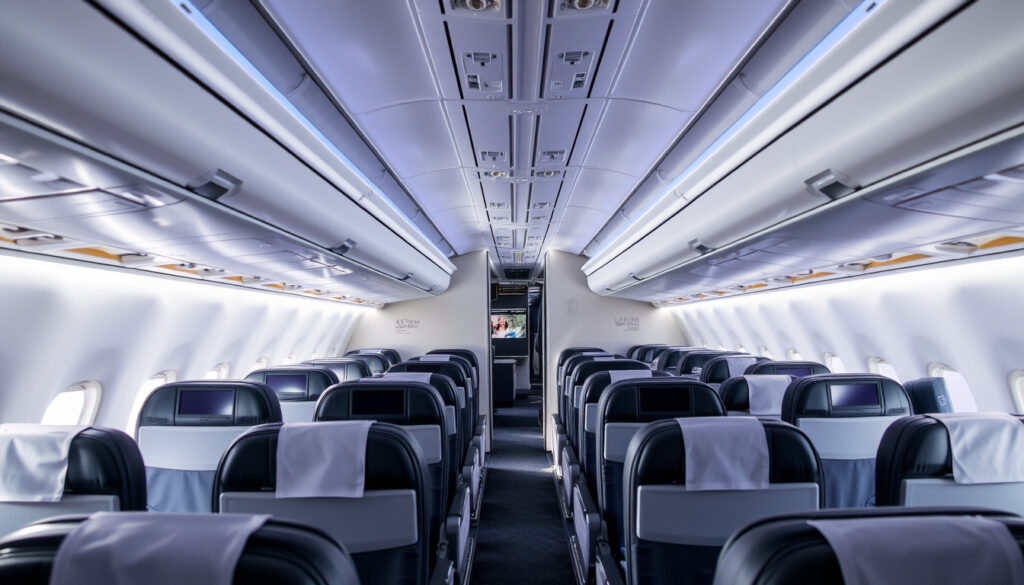
Air NZ 787-9 Seat Map: Business, Premium Economy & Economy
Anyone who has ever booked a long-haul flight knows the seat map can make or break the experience. On Air New Zealand’s 787-9 Dreamliner, the layout varies between two main versions, and understanding the difference between the 302-seat V5 and the 294-seat V3 configuration is the key to a comfortable journey across the Pacific.
Total seats: 302 ·
Business class seats: 18 ·
Premium Economy seats: 21 ·
Economy seats: 263 ·
Economy seat pitch: 31-33 inches (78-84 cm) ·
Cabin versions: V5 and V3
Quick snapshot
- Air New Zealand operates the 787-9 with 302 seats in the V5 configuration (Air New Zealand official seat map)
- Business Premier has 18 lie-flat seats in rows 1-6 (Air New Zealand official seat map)
- Premium Economy has 21 seats with 41-inch pitch (Air New Zealand official seat map)
- Economy has 263 seats with 31-33 inch pitch (Air New Zealand official seat map)
- Exact seat dimensions may vary by row within the same cabin
- Some seats may have limited recline due to bulkhead placement
- Seat selection fees are subject to change without notice
- V5 configuration is the most common currently in service
- V3 configuration operates on select routes alongside V5
- Future Skynest sleep pods may alter future configurations
- Check the official seat map on airnewzealand.com before booking
- Skynest (economy sleep pods) could arrive on future 787-9 deliveries
- Seat selection fees vary by fare type and route
| Specification | Value |
|---|---|
| Aircraft model | Boeing 787-9 Dreamliner |
| Airline | Air New Zealand |
| Total seats | 302 (V5) / 294 (V3) |
| Business class seats | 18 (V5) / 22 (V3) |
| Premium Economy seats | 21 (V5) / 52 (V3) |
| Economy seats | 263 (V5) / 125 (V3 main deck) |
| Economy seat pitch | 31-33 inches (78-84 cm) |
| Business class pitch | 78 inches (lie-flat) |
| Cabin versions | V5 and V3 |
The pattern: V5 maximizes economy capacity, while V3 dedicates more space to premium cabins, giving passengers a clear trade-off depending on their class of travel.
What is the economy seat map on the Air New Zealand 787-9?
Seat count and layout
Economy on the V5 configuration holds 263 seats in rows 34 through 65, arranged in a standard 3-3-3 layout across the width of the cabin (Air New Zealand official seat map). That means 9 seats per row, with two aisles running the length of the section. The V3 configuration, by contrast, places 125 economy seats in rows 35 to 49, also in a 3-3-3 configuration, but the shorter cabin length reflects the V3’s larger premium cabins (Air New Zealand V3 official seat map).
Seat pitch and width
Air New Zealand lists economy seat pitch at 31 to 33 inches (78 to 83 cm) on the V5, depending on the row (Air New Zealand official seat map). The V3 version offers 31 to 32 inches (78 to 81 cm) in standard rows (Air New Zealand V3 official seat map). Seat width is approximately 17 inches, a typical figure for the 787-9’s economy cabin, based on independent guides (Cabin Coach travel guide).
Best and worst seats in economy
- Extra legroom: Economy Skycouch rows (36-43 ABC and 36-41 HJK on V5) offer 32-33 inches of pitch and the ability to turn three seats into a flat zone (Air New Zealand official seat map).
- Economy Stretch (V3): Row 36 ABC and rows 36-40 HJK provide 35 inches of pitch on the V3 configuration (Air New Zealand V3 official seat map).
- Seats to avoid: Rows near the rear galley or lavatories may have limited recline or increased noise. Seats at the very back of the cabin (row 65 on V5) can also feel narrower due to fuselage taper.
Row 34-65 details
Rows 34 through 65 on the V5 cover the entire economy section. Rows 34 is the first row after Premium Economy, separated by a bulkhead, which means limited underseat storage but extra legroom in some seats. Rows 36-43 feature the Skycouch product on the window sides (ABC and HJK) (Air New Zealand official seat map). The V3 economy runs from row 35 to 49, with Skycouch in rows 37-39 ABC and 41-46 HJK (Air New Zealand V3 official seat map).
What is the business class seat map on the Air New Zealand 787-9?
Business class layout and seat count
Business Premier on the V5 configuration occupies rows 1 through 6, with 18 seats in a 1-2-1 layout (Air New Zealand official seat map). Every seat has direct aisle access — no one has to climb over a neighbor. The 1-2-1 configuration means window seats alternate between being closer to the window or the aisle, a common pattern on the 787-9.
Lie-flat bed features
All 18 Business Premier seats convert into fully lie-flat beds, with a pitch of approximately 78 inches once fully extended, according to the airline’s published specifications (Air New Zealand official seat map). Each seat is equipped with a personal 18-inch entertainment screen, universal power outlets, and direct aisle access. The seat width is listed at 20 inches, making it one of the broader business-class seats on the 787-9 (Cabin Coach travel guide).
Row 1-6 seating details
- Row 1: Bulkhead row — no overhead bin directly above on some seats, but more legroom. Preferred by taller passengers.
- Rows 2-5: Standard Business Premier seats with full lie-flat capability and storage.
- Row 6: Last row of Business Premier — close to the galley and lavatories, but also close to the Premium Economy cabin for a quieter forward section.
Direct aisle access and privacy
The 1-2-1 configuration means every passenger has a direct path to the aisle without stepping over anyone. Window seats (A and K) offer the most privacy, with a small console table between the seat and the aisle. Center seats (D and G in the 1-2-1 pattern) are paired, making them a good choice for couples traveling together.
Business Premier on the 787-9 is a genuinely competitive product for Pacific routes. The 1-2-1 layout ensures no passenger is stuck in a middle seat, and the lie-flat bed covers the full 78-inch pitch. The catch: only 18 seats exist on the V5, so early booking is essential.
What is the premium economy seat map on the Air New Zealand 787-9?
Premium economy seat count and rows
Premium Economy on the V5 configuration sits in rows 23 through 25, with 21 seats arranged in a 2-3-2 layout (Air New Zealand official seat map). The V3 version, by contrast, offers a much larger Premium Economy cabin — rows 23 through 30, with 52 seats in a 2-4-2 configuration (Air New Zealand V3 official seat map). This is one of the most significant differences between the two versions.
Seat pitch and recline
Air New Zealand lists Premium Economy seat pitch at 41 inches (104 cm) on both the V5 and V3 configurations (Air New Zealand official seat map). That is roughly 8-10 inches more than standard economy, and the recline is also noticeably deeper — typically 7-8 inches versus economy’s 3-4 inches. The seat width is approximately 18.5 inches, providing extra shoulder room compared to economy.
Comparison with economy
| Feature | Premium Economy | Economy |
|---|---|---|
| Seat pitch | 41 inches (104 cm) | 31-33 inches (78-84 cm) |
| Seat width | ~18.5 inches | ~17 inches |
| Recline | 7-8 inches | 3-4 inches |
| Configuration | 2-3-2 (V5) / 2-4-2 (V3) | 3-3-3 |
| Meal service | Enhanced, with glassware | Standard economy |
The implication: Premium Economy passengers get nearly double the recline and significantly more pitch than economy, making it the clear sweet spot for value on long Pacific flights.
Row 23-25 details
On the V5, rows 23-25 are the entire Premium Economy cabin. Row 23 is a bulkhead row with extra legroom but limited underseat storage. Rows 24 and 25 are standard Premium Economy rows. The 2-3-2 layout means window seats (A and K) are in pairs, center seats (D, E, F) are a triple, and aisle seats (C and J) are widely available. On the V3, rows 23-30 offer a larger 2-4-2 layout, with row 23 again being a bulkhead row.
How many seats are on the Air New Zealand 787-9 and what is the overall configuration?
Total seat count: 302
The V5 configuration of the Air New Zealand 787-9 seats 302 passengers across three classes: 18 in Business Premier, 21 in Premium Economy, and 263 in Economy (Air New Zealand official seat map). The V3 configuration seats 294 passengers, with a different distribution: 22 in Business Premier, 52 in Premium Economy, and 125 in Economy on the main deck, plus additional economy seats on the upper deck area (Air New Zealand V3 official seat map).
Cabin breakdown by class
- Business Premier: 18 seats (V5) / 22 seats (V3) — 1-2-1 configuration, fully lie-flat
- Premium Economy: 21 seats (V5) / 52 seats (V3) — 2-3-2 or 2-4-2 configuration
- Economy: 263 seats (V5) / 125 seats (V3 main deck) — 3-3-3 configuration
Version differences (V5 vs V3)
The V5 and V3 configurations are both in service, and the airline operates a mixed fleet. The key difference lies in the premium cabin allocation: V5 favors a larger economy cabin with a smaller Premium Economy section, while V3 allocates more seats to Premium Economy and Business Premier. This means passengers on a V3 aircraft have a better chance of scoring a Premium Economy seat, but the economy cabin is smaller.
Seat configuration diagrams
Official seat maps are available on Air New Zealand’s website for both the V5 configuration and the V3 configuration. Third-party aggregators like SeatMaps seat map aggregator also transcribe these layouts, but the official airline source remains the most reliable.
The V3 configuration’s larger Premium Economy cabin (52 seats versus 21) is a major differentiator. If you are specifically booking Premium Economy, check whether your flight is operated by a V5 or V3 aircraft — the seat availability and cabin feel differ substantially.
What are the differences between the Air New Zealand 787-9 seat map versions V5 and V3?
Seat count differences
The most obvious difference is the total seat count: 302 on V5 versus 294 on V3. But the distribution varies even more. On V5, the airline prioritizes economy capacity with 263 seats. On V3, the airline shifts the balance toward premium cabins, with 52 Premium Economy seats and 22 Business Premier seats (Air New Zealand official seat map).
Cabin class arrangement
| Class | V5 | V3 |
|---|---|---|
| Business Premier | 18 seats (rows 1-6, 1-2-1) | 22 seats (varied rows, 1-2-1) |
| Premium Economy | 21 seats (rows 23-25, 2-3-2) | 52 seats (rows 23-30, 2-4-2) |
| Economy | 263 seats (rows 34-65, 3-3-3) | 125 seats (rows 35-49, 3-3-3) |
The pattern is clear: V5 is built for economy density, while V3 is built for premium density. This affects everything from seat availability to the overall cabin atmosphere.
Aircraft delivery dates
Air New Zealand took delivery of its first 787-9 in 2014. The V5 configuration is the more modern version, introduced with later deliveries. The V3 configuration represents an earlier cabin layout. Both versions remain in service, and the airline does not guarantee which configuration will operate on a specific route — it depends on aircraft rotation (Air New Zealand official seat map).
Which version is currently in service
Both V5 and V3 configurations are active in the Air New Zealand fleet. The airline operates a mix of 787-9 aircraft, and the specific configuration assigned to a flight depends on the aircraft’s schedule. Passengers can check the seat map during booking on the airline’s website to see which version is assigned to their flight.
Specification table: Air New Zealand 787-9 seat map
Nine key specifications, one pattern: the V5 and V3 configurations trade off between economy density and premium capacity.
| Specification | V5 | V3 |
|---|---|---|
| Total seats | 302 | 294 |
| Business Premier seats | 18 | 22 |
| Premium Economy seats | 21 | 52 |
| Economy seats | 263 | 125 |
| Economy pitch | 31-33 inches | 31-32 inches |
| Premium Economy pitch | 41 inches | 41 inches |
| Business class pitch | 78 inches (lie-flat) | 78 inches (lie-flat) |
| Economy configuration | 3-3-3 | 3-3-3 |
| Premium Economy config | 2-3-2 | 2-4-2 |
The implication: the V5 is the high-density workhorse, while the V3 offers a more premium-heavy layout. For passengers booking Premium Economy, the V3 is the better bet — more seats and a wider cabin.
Confirmed facts and what remains unclear
Confirmed facts
- Air New Zealand operates the Boeing 787-9 with 302 seats in the V5 configuration (Air New Zealand official seat map)
- Business Premier has 18 lie-flat seats in rows 1-6 on V5 (Air New Zealand official seat map)
- Premium Economy offers 41 inches of pitch on both V5 and V3 (Air New Zealand official seat map)
- Economy Skycouch is available on rows 36-43 ABC and 36-41 HJK on V5 (Air New Zealand official seat map)
- Official seat maps are published on airnewzealand.com (Air New Zealand official seat map)
What’s unclear
- Exact seat dimensions (width and pitch) may vary by row within the same cabin
- Some seats may have limited recline due to bulkhead or galley placement
- Seat selection fees are subject to change and vary by fare type
- The exact number of V3 versus V5 aircraft in the fleet is not publicly fixed
Passenger perspectives on the Air New Zealand 787-9 seat map
Air New Zealand’s official seat map page states: “View the Boeing 787-9 seat map with cabin layout, seating configuration, and position details” (Air New Zealand national carrier). The airline positions the seat map as a planning tool for passengers to select their preferred seat before travel.
Independent guides like Cabin Coach travel guide describe the economy cabin as “3-3-3 with 31 inches of pitch and approximately 17 inches of seat width,” noting that the Skycouch product is a “unique selling point for families.” The guide also highlights that business class offers “20 inches of width and a 79-inch bed,” making it one of the more comfortable options on trans-Pacific routes.
According to SeatRecon aviation seat mapping specialist, the 275-seat V2 configuration (an earlier variant) was transcribed seat-for-seat from Air New Zealand’s published maps, showing 27 Business Premier seats, 33 Premium Economy, and 215 Economy. This older configuration is now largely replaced by V5 and V3.
seatmaps.com, airnewzealand.com, seatmaps.com, aucklandjournal.nz, seatmaps.com, seatmaps.com, seatmaps.com, aerolopa.com
FAQ: Air New Zealand 787-9 seat map
Can I choose a seat with extra legroom on the Air New Zealand 787-9?
Yes. Economy Skycouch rows (36-43 ABC and 36-41 HJK on V5) offer 32-33 inches of pitch. On V3, Economy Stretch rows (36 ABC and 36-40 HJK) provide 35 inches of pitch. These seats typically incur a selection fee.
What is the seat selection fee on Air New Zealand?
Seat selection fees vary by fare type, route, and seat category. Standard economy seats may be free at check-in, while Skycouch, Economy Stretch, and exit-row seats require an additional fee. Check your booking for exact pricing.
Are there power outlets in economy class on the 787-9?
Yes. Every seat on the Air New Zealand 787-9, including economy, has a personal USB port and a universal power outlet. The 787-9 is equipped with seatback entertainment screens in all cabins.
Which seats on the 787-9 have the best recline?
Business Premier seats recline to a fully lie-flat bed. Premium Economy seats offer 7-8 inches of recline. In economy, standard recline is 3-4 inches. Avoid bulkhead rows if you prefer full recline, as some may have limited recline due to the wall.
How do I access the seat map for my Air New Zealand flight?
Log in to your booking on airnewzealand.com and select “Seat selection.” The seat map for your specific flight will show the configuration (V5 or V3) and available seats. You can also view the generic seat maps on the airline’s website.
What is the seat width in economy on the 787-9?
Economy seat width on the Air New Zealand 787-9 is approximately 17 inches (43 cm). This is standard for the 787-9 Dreamliner’s 3-3-3 configuration. Premium Economy offers approximately 18.5 inches of width.
Does the Air New Zealand 787-9 have Wi-Fi?
Yes, the Air New Zealand 787-9 is equipped with satellite Wi-Fi. The service is available for purchase on most flights, with pricing varying by route and duration. Streaming is supported on most aircraft.
Summary: What this means for your next booking
The Air New Zealand 787-9 seat map comes in two distinct versions, and the version on your flight changes the experience. The V5 is the high-density workhorse with 302 seats, a small Premium Economy cabin, and a vast economy section. The V3 is the premium-heavy variant with 294 seats, a large Premium Economy cabin, and a smaller economy section. The difference is not minor — it affects everything from seat availability to cabin noise and comfort. For passengers booking Premium Economy, the V3 is the better option. For economy passengers, both versions offer similar pitch and width, but the V5 has more seats available. Always check the seat map at booking time, and if you are flying on a specific route, consider searching for which version typically operates that route. The trade-off between V5 and V3 is real, and knowing which one you are getting is the single best way to ensure a comfortable flight. Passengers booking Premium Economy should specifically target V3 flights for the best seat availability and cabin experience.
More related posts
 Auckland to Kuala Lumpur Flights: Time, Prices & Airlines
 A’mano Authentic Pasta & Cucina: Handmade Italian in Christchurch
 Jamie Oliver Air Fryer: Recommendations, Reviews & Tips
 What Is an Email Alias – Definition, Setup and Privacy Benefits
 Rufus Du Sol NZ 2025: Auckland Show & Tour Guide | Tickets
 State Highway 1 Clo ure Today: Live Update & How to Check
 What Is a Pantry Moth? Identification, Causes & Removal Guide
 Narendra Modi (@narendramodi) Biography, Achievements & Life